Visualizzazione post con etichetta associations. Mostra tutti i post

venerdì 22 maggio 2026

ASSOCIATIONS, A RESOURCE


ADDRESS OF POPE LEO XIV

TO PARTICIPANTS IN THE MEETING WITH
THE MODERATORS OF ASSOCIATIONS OF THE 
FAITHFUL, ECCLESIAL MOVEMENTS, AND NEW COMMUNITIES


English - Español - Français - Italiano - Português

Synod Hall Thursday, 21 May 2026

________________________

In the name of the Father, and of the Son, and of the Holy Spirit.

Peace be with you!

Dear brothers and sisters, good morning to you all!

It is a please to meet with you this morning, to offer some words, some reflections, but above all to think about the importance of the charisms of the Holy Spirit, especially in these days before Pentecost.

I am delighted to welcome you once again this year, at the start of your meeting. You hold positions of responsibility, at an international level, within many different lay organisations, and you have been invited by the Dicastery for the Laity, Family and Life to strengthen the bonds of communion amongst you and to reflect together on the theme of the governance of an ecclesial community.

Adequate people and structures

In every social entity there exists a need for suitable people and structures to guide and coordinate communal life. At its root, the term “to govern” refers to the action of “holding the helm”, of “steering a ship”. It is, therefore, a matter of providing a sure direction, so that the community may be a place of growth for the people who belong to it. Thus, in the Church too, some are assigned to governance.

However, in the Church, governance does not arise simply from the need to coordinate the religious needs of its members. The Church was established by Christ as a lasting sign of His universal salvific will and is the place, willed by God, where all people, in every age, may receive the fruits of Redemption and experience the new life that Christ has given us. In this sense, the nature of the Church is sacramental: it certainly has an external and institutional dimension with its structures and, at the same time, is an effective sign of communion through which we participate in the very life of the Trinity.

These distinctive characteristics of the Church are by necessity also present in its governance, which is never merely technical; on the contrary, it has a salvific orientation in itself, that is, it must be directed towards the spiritual good of the faithful. Indeed, Saint Paul counts it among the charisms: there are “workers of miracles”, he writes, “then healers, helpers, administrators, speakers in various kinds of tongues” (1 Cor 12:28).

Service and democracy

With these premises in mind, let us now turn our attention to associations of the faithful and ecclesial movements. Here, governance is generally entrusted to laypeople and expresses participation in the royal munus of Christ received in Baptism. It is placed at the service of other faithful and of the life of the association, and is the fruit of free elections, which must be understood as an expression of common discernment: allowing everyone’s voice to be freely expressed.

If, as we have said, governance is a particular gift of the Holy Spirit, which the members of a community recognize as present in some of their brethren in the faith, at least three consequences derive from this. The first is that it must be for the benefit of all (cf. 1 Cor 12:7), that is, to promote the good of the community, of the association, and of the whole Church. Governance, therefore, can never be exploited for personal interests or worldly forms of prestige and power. The second consequence is that it can never be imposed from above, but must be a gift recognizable within the community and freely accepted; hence the importance of free elections to bring it into effect. The third consequence is that, like every charism, the governance of an association is also subject to the discernment of the Pastors, who monitor the authenticity and orderly use of charisms (cf. Lumen gentium, 12; Iuvenescit Ecclesia, 9 and 17).

Relationity and co-responsability

Certain characteristics must always be present in governance: mutual listening, shared responsibility, transparency, fraternal closeness, and communal discernment (cf. Address to the participants in the General Chapter of the Legionaries of Christ, 19 February 2026). In addition to this, I would like to recall that “good governance, instead of focusing everything on itself, promotes subsidiarity and the responsible participation of all the members of the community” (ibid.). These are simple guidelines, but ones always to be kept in mind in the exercise of authority.

Prophecy, custody and valorization

Dear friends, your associations and movements have different origins and possess well-defined histories, identities and ideals. Those who govern them, therefore, take on a delicate task: on the one hand, they are called to safeguard and promote the memory of a living heritage; on the other, they have a “prophetic” role, which involves listening to current pastoral needs in order to understand how to respond to the new challenges and to the cultural, social and spiritual sensibilities of our time. Indeed, only in this way can one be a Christian, a disciple and a missionary in today’s society and Church. Part of the prophetic task of those in leadership, therefore, is to promote the openness of the association or movement—and of each of its members—to historical situations. Membership, in fact, is authentic and fruitful when it is not limited to participation in activities within the group, but interprets the signs of the times and reaches outwards, addressing everyone, the culture of the times and mission areas that have not yet been explored.

Communion and mutual listening

Another element of vital importance is communion. Those who govern are required to have a particular sensitivity towards the safeguarding, growth and consolidation of communion. This applies both to life within the association or movement, and to communion with other ecclesial realities and with the Church as a whole. Those who exercise a mission of leadership in the Church must learn to listen to and welcome different opinions, different cultural and spiritual orientations, and different personal temperaments, always seeking to preserve, especially in necessary and often difficult decisions, the greater good of communion. This requires a witness of meekness, detachment and selfless love for one’s brothers and sisters and for the community, which serves as an example to everyone.

Here I would like to emphasize the importance of this dimension of communion with the Church as a whole. At times we find groups who close themselves up and think that their specific reality is the only one, or that it is the Church, but the Church is all of us, it is much more! And so our movements must truly endeavour to live in communion with the entire Church, at diocesan level. The bishop is therefore a very important figure of reference, and if a group says, “No, we are not in communion with this bishop, we want another one”, this will not do. We must try to live in communion with all the Church, at diocesan level as well as at universal level.

Fidelity to charisma

In this light, we can better understand the meaning of fidelity to the founding charism, which constitutes an indispensable point of reference for the governance of an ecclesial community. Every authentic charism already contains within itself fidelity and openness to the Church. To govern in a manner faithful to the founding charism therefore means finding in it the inspiration to open oneself to the journey the Church is undertaking in the present, without becoming entrenched in the models—however positive—of the past, but allowing oneself to be challenged by new realities and challenges, in dialogue with all the other members of the ecclesial body.

Give yourself a gift

Dear friends, thank you for all that you are and all that you do. Associations of the faithful and ecclesial movements are an inestimable gift to the Church. There is great richness amongst you: so many well-formed people and so many fine evangelizers; so many young people and diverse vocations to the priesthood and married life. The variety of charisms, gifts and methods of apostolate developed over the years allows you to be present in the fields of culture, art, social life and work, bringing the light of the Gospel everywhere. Cherish and, with God’s grace, nurture all these gifts! The Church supports and accompanies you.

I bless you from the heart, invoking for all of you the intercession of the Virgin Mary, Mother of the Church.

___________________________________


              English - Español - Français - Italiano - Português


Holy See Press Office Bulletin, 21 May 2026


sabato 7 giugno 2025

UNITY YEAST - LEUVRE D'UNITE' - LEVADURA DE UNIDAD


 IT - EN - FR- ES

UMEC-WUCT

IN PREPARAZIONE AL GIUBILEO DEL MONDO EDUCATIVO


Una settimana intensa di lavoro, a Roma, in preparazione del Giubileo per il mondo educativo che si svolgerà dal 31 ottobre al 2 novembre.

Si è definita la bozza di un intenso programma di attività (già discusso dal Comitato Esecutivo dell’UMEC-WUCT nell’incontro di febbraio a Cambrai). Si sono contattati molti relatori, si è interagito con varie istituzioni. Ogni giorno si sono percorsi vari chilometri a piedi (una media di sei km al giorno). Si sono scritte e inviate varie lettere per cercare benefattori disposti ad aiutare l’Unione a ridurre i notevoli costi dell’evento e a sostenere gli educatori provenienti da realtà disagiate. È stato un lavoro complesso, svolto con impegno e competenza, anche grazie alla operosa e instancabile presenza, in particolare, del presidente. La calorosa e tradizionale ospitalità dell’AIMC ha favorito - come sempre- il lavoro dell’Unione.

Il lavoro deve essere portato a termine nel più breve tempo possibile. Infatti, per organizzare adeguatamente l’evento, l’ospitalità, le varie attività è necessario conoscere il numero dei partecipanti e ricevere tutte le altre informazioni richieste in questo anno …. Nei prossimi giorni pubblicheremo nel blog https://wuct-umec.blogspot.com e nel sito https://www.umec-wuct.org/ il programma (che è in via di definizione). Naturalmente, occorre un generoso, costante e vivace impegno da parte di tutti.

Due giornate sono state dedicate all’incontro dei responsabili internazionali delle associazioni riconosciute dalla Santa Sede, con relazioni tenute dal Prefetto del Dicastero per i Laici-Famiglia-Vita e da vari esperti, e lavori di gruppo. È stata l’occasione per interagire con varie e interessanti realtà, oltre che per riflettere sul ruolo delle associazioni e dei movimenti e delle sfide odierne e future. Il tema dell’incontro è stato “La speranza vissuta e annunciata: il dono del Giubileo per le aggregazioni ecclesiali”.

Il Santo Padre ha voluto incontrare i partecipanti all’incontro, manifestando apprezzamento per il lavoro svolto dalle associazioni e dai movimenti, ha rivolto loro un discorso, che un’ottima occasione per la riflessione per tutti coloro che in vario modo fanno parte delle associazioni e dei movimenti. Papa Leone ha benedetto non solo i presenti all’udienza, ma tutti coloro che vivono con impegno nelle realtà associative.

DISCORSODEL SANTO PADRE LEONE XIV AI MODERATORI DELLE ASSOCIAZIONI DI FEDELI, DEIMOVIMENTI ECCLESIALI E DELLE NUOVE COMUNITÀ

A scanso di equivoci, l’incontro era strettamente riservato agli invitati dal Dicastero.


AT WORK FOR THE JUBILEE OF THE EDUCATIONAL WORLD


An intense week of work, in Rome, in preparation for the Jubilee for the educational world that will take place from October 31st to November 2nd.

A draft of an intense program of activities was defined (already discussed by the Executive Committee of UMEC-WUCT at the February meeting in Cambrai). Many speakers were contacted, and various institutions were interacted with. Several kilometers were walked every day (an average of six km per day). Various letters were written and sent to seek benefactors willing to help the Union reduce the considerable costs of the event and support educators from disadvantaged backgrounds. It was a complex job, carried out with commitment and competence, also thanks to the industrious and tireless presence, in particular, of the president. The warm and traditional hospitality of the AIMC favored - as always - the work of the Union.

The work must be completed in the shortest possible time. In fact, to properly organize the event, the hospitality, the various activities it is necessary to know the number of participants and receive all the other information requested in this year .... In the next few days we will publish the program (which is being defined) on the blog https://wuct-umec.blogspot.com and on the website https://www.umec-wuct.org/ . Naturally, a generous, constant and lively commitment from everyone is needed.

Two days were dedicated to the meeting of the international leaders of the associations recognized by the Holy See, with reports given by the Prefect of the Dicastery for the Laity-Family-Life and by various experts, and group work. It was an opportunity to interact with various and interesting realities, as well as to reflect on the role of associations and movements and the challenges of today and the future. The theme of the meeting was “ Hope lived and announced: the gift of the Jubilee for ecclesial aggregations ” .

The Holy Father wanted to meet the participants of the meeting, expressing appreciation for the work done by the associations and movements, he addressed them with a speech, which is an excellent opportunity for reflection for all those who in various ways are part of the associations and movements. Pope Leo blessed not only those present at the audience, but all those who live with commitment in the associative realities.

ADDRESS OF HIS HOLINESS POPE LEO XIV TO THE MODERATORSOF THE ASSOCIATIONS OF THE FAITHFUL, OF THE ECCLESIAL MOVEMENTS AND OF THE NEWCOMMUNITIES

To avoid any misunderstanding, the meeting was  strictly reserved for those invited by the Dicastery.


AU TRAVAIL POUR LE JUBILÉ DU MONDE ÉDUCATIF


Une semaine de travail intense, à Rome, en préparation du Jubilé du monde éducatif qui se tiendra du 31 octobre au 2 novembre.

Un programme d'activités dense a été défini (déjà discuté par le Comité exécutif de l'UMEC-WUCT lors de la réunion de février à Cambrai). De nombreux intervenants ont été contactés et diverses institutions ont été contactées. Chaque jour, plusieurs kilomètres ont été parcourus à pied (en moyenne six kilomètres par jour). Divers courriers ont été rédigés et envoyés afin de rechercher des donateurs disposés à aider l'Union à réduire les coûts considérables de l'événement et à soutenir les enseignants issus de milieux défavorisés. Ce fut un travail complexe, mené avec engagement et compétence, notamment grâce à la présence active et infatigable du président. L'hospitalité chaleureuse et traditionnelle de l'AIMC a favorisé, comme toujours, le travail de l'Union.

Les travaux devaient être menés à bien dans les meilleurs délais. En effet, pour organiser correctement l'événement, l'accueil et les différentes activités, il est nécessaire de connaître le nombre de participants et de recevoir toutes les autres informations demandées cette année. Dans les prochains jours, nous publierons le programme (en cours de définition) sur le blog https://wuct-umec.blogspot.com et sur le site web https://www.umec-wuct.org/. Bien entendu, un engagement généreux, constant et dynamique de la part de chacun est nécessaire.

Deux jours ont été consacrés à la rencontre des responsables internationaux des associations reconnues par le Saint-Siège, avec des rapports du Préfet du Dicastère pour les Laïcs-Famille-Vie et de divers experts, ainsi qu'à des travaux de groupe. Ce fut l'occasion d'interagir avec des réalités diverses et intéressantes, et de réfléchir au rôle des associations et des mouvements, ainsi qu'aux défis d'aujourd'hui et de demain. Le thème de la rencontre était « L'espérance vécue et annoncée : le don du Jubilé pour les agrégations ecclésiales ». Le Saint-Père a souhaité rencontrer les participants à la rencontre, exprimant sa reconnaissance pour le travail accompli par les associations et les mouvements, et s'est adressé à eux dans un discours qui a constitué une excellente occasion de réflexion pour tous ceux qui, à divers titres, participent à ces associations et mouvements. Le pape Léon XIII a béni non seulement les personnes présentes à l'audience, mais aussi tous ceux qui vivent avec engagement dans le monde associatif.

DISCOURS DU SAINT-PÈRE LÉON XIV AUXMODÉRATEURS DES ASSOCIATIONS DE FIDÈLES, DES MOUVEMENTS ECCLÉSIAUX ET DESCOMMUNAUTÉS NOUVELLES

 Afin d'éviter tout malentendu, la rencontre était strictement réservée aux personnes invitées par le Dicastère

 ***************************************************************


EN EL TRABAJO PARA EL JUBILEO DEL MUNDO DE LA EDUCACIÓN

 Una intensa semana de trabajo en Roma, en preparación para el Jubileo del mundo de la educación, que tendrá lugar del 31 de octubre al 2 de noviembre.

Se definió el borrador de un intenso programa de actividades (ya debatido por el Comité Ejecutivo de la UMEC-WUCT en la reunión de febrero en Cambrai). Se contactó a numerosos ponentes y se interactuó con diversas instituciones. Diariamente se recorrieron varios kilómetros a pie (un promedio de seis km por día). Se escribieron y enviaron diversas cartas para buscar benefactores dispuestos a ayudar a la Unión a reducir los considerables costes del evento y a apoyar a los educadores de entornos desfavorecidos. Fue una labor compleja, realizada con compromiso y competencia, gracias también a la presencia diligente e incansable, en particular, del presidente. La cálida y tradicional hospitalidad de la AIMC favoreció, como siempre, la labor de la Unión.

El trabajo debe completarse lo antes posible. De hecho, para organizar adecuadamente el evento, la hospitalidad y las diversas actividades, es necesario conocer el número de participantes y recibir toda la información solicitada este año. En los próximos días publicaremos el programa (que se está definiendo) en el blog https://wuct-umec.blogspot.com y en la página web https://www.umec-wuct.org/. Naturalmente, se requiere un compromiso generoso, constante y dinámico por parte de todos.

Dos días se dedicaron a la reunión de los líderes internacionales de las asociaciones reconocidas por la Santa Sede, con informes del Prefecto del Dicasterio para los Laicos, la Familia y la Vida y de diversos expertos, y trabajo en grupo. Fue una oportunidad para interactuar con diversas e interesantes realidades, así como para reflexionar sobre el papel de las asociaciones y los movimientos y los desafíos actuales y futuros. El tema del encuentro fue «La esperanza vivida y anunciada: el don del Jubileo para las congregaciones eclesiales». El Santo Padre quiso reunirse con los participantes en la reunión, expresando su aprecio por la labor de las asociaciones y movimientos, y les dirigió un discurso, que constituyó una excelente oportunidad de reflexión para quienes, de diversas maneras, forman parte de ellas. El Papa León bendijo no solo a los presentes en la audiencia, sino también a todos aquellos que viven con compromiso en el mundo asociativo.

DISCURSO DEL SANTO PADRE LEÓN XIV

A LOS MODERADORES DE LAS ASOCIACIONES DE FIELES,

DE LOS MOVIMIENTOS ECLESIALES Y DE LAS NUEVAS COMUNIDADES

 Para evitar cualquier malentendido, la reunión estuvo reservada exclusivamente a los invitados por el Dicasterio

venerdì 14 giugno 2024

POPE FRANCIS: A SHARED STYLE

 EN  - IT ]

SPEECH OF THE HOLY FATHER FRANCIS
TO PARTICIPANTS IN THE ANNUAL MEETING WITH I
MODERATORS OF THE FAITHFUL ASSOCIATIONS,
OF ECCLESIAL MOVEMENTS AND NEW COMMUNITIES
PROMOTED BY THE DEPARTMENT FOR THE LAITY, THE FAMILY AND LIFE

Aula del Sinodo
Giovedì, 13 giugno 2024

[Multimedia]

_ EN  - IT ]___

Eminenza, cari fratelli e sorelle, buongiorno e benvenuti tutti!

Sono contento di incontrarvi, e colgo l’occasione per riflettere con voi sulla sinodalità, che avete scelto come tema della vostra giornata di incontro. Più volte ho ripetuto che il cammino sinodale richiede una conversione spirituale, perché senza un cambiamento interiore non si raggiungono risultati duraturi. Il mio desiderio, infatti, è che, dopo questo Sinodo, la sinodalità rimanga come modo di agire permanente nella Chiesa, a tutti i livelli, entrando nel cuore di tutti, pastori e fedeli, fino a diventare uno “stile ecclesiale” condiviso. Tutto ciò, però, richiede un cambiamento che deve avvenire in ognuno di noi, una vera e propria “conversione”.

È stato un cammino lungo. Pensate che il primo che ha visto che c’era bisogno della sinodalità nella Chiesa latina è stato San Paolo VI, quando dopo il Concilio ha creato il Segretariato per il Sinodo dei Vescovi. La Chiesa orientale aveva conservato la sinodalità, invece la Chiesa latina l’aveva persa. È stato San Paolo VI ad aprire questa via. E oggi, a quasi 60 anni, possiamo dire che la sinodalità è entrata nel modo di agire della Chiesa. La cosa più importante di questo Sinodo sulla sinodalità non è tanto trattare questo problema o quell’altro. La cosa più importante è il cammino  parrocchiale, diocesano e universale nella sinodalità.

E nell’ottica di questa conversione spirituale provo ora a indicare alcuni atteggiamenti, alcune “virtù sinodali”, che possiamo desumere dai tre annunci della Passione nel Vangelo di Marco (cfr 8,31; 9,31; 10,32-34): pensare secondo Diosuperare ogni chiusura e coltivare l’umiltà.

Primo: pensare secondo Dio. Dopo il primo annuncio della Passione, l’Evangelista ci riferisce che Pietro rimprovera Gesù. Proprio lui, che doveva essere di esempio e aiutare gli altri discepoli ad essere pienamente a servizio dell’opera del Maestro, si oppone ai piani di Dio, rifiutandone la passione e la morte. E Gesù gli dice: «Tu non pensi secondo Dio, ma secondo gli uomini» (Mc 8,32).

Ecco il primo grande cambiamento interiore che ci viene chiesto: passare da un “pensiero solo umano” al “pensiero di Dio”. Nella Chiesa, prima di prendere ogni decisione, prima di iniziare ogni programma, ogni apostolato, ogni missione, dovremmo sempre chiederci: cosa vuole Dio da me, cosa vuole Dio da noi, in questo momento, in questa situazione? Quello che io ho in mente, quello che noi come gruppo abbiamo in mente, è veramente il “pensiero di Dio”? Ricordiamoci che il protagonista del cammino sinodale è lo Spirito Santo, non noi. Lui solo ci insegna ad ascoltare la voce di Dio, individualmente e come Chiesa.

Dio è sempre più grande delle nostre idee, è più grande della mentalità dominante, delle “mode ecclesiali” del momento, anche del carisma del nostro particolare gruppo o movimento. Perciò, non diamo mai per scontato di essere “sintonizzati” con Dio: cerchiamo piuttosto sempre di elevarci al di sopra di noi stessi per convertirci a pensare secondo Dio e non secondo gli uomini. Questa è la prima grande sfida. Pensare secondo Dio. Pensiamo a quel passo del Vangelo quando il Signore annuncia la Passione e Pietro si oppone. Cosa dice il Signore? “Tu non sei secondo Dio, tu non pensi secondo Dio”.

Secondo: superare ogni chiusura. Dopo il secondo annuncio della Passione, Giovanni si oppone a un uomo che praticava un esorcismo nel nome di Gesù, ma non era della cerchia dei discepoli: «Volevamo impedirglielo – afferma – perché non ci seguiva!» (Mc 9,38). Gesù non approva questo suo atteggiamento e gli dice: «Chi non è contro di noi è per noi» (Mc 9,40); poi invita tutti gli Apostoli a vigilare piuttosto su sé stessi, per non essere occasione di scandalo per gli altri (cfr Mc 9,42-50).

Stiamo attenti per favore alla tentazione del “cerchio chiuso”. I Dodici erano stati scelti per essere il fondamento del nuovo popolo di Dio, aperto a tutte le nazioni della terra, ma gli Apostoli non colgono questo orizzonte grande: si ripiegano su sé stessi e sembrano voler difendere i doni ricevuti dal Maestro – guarire i malati, cacciare i demoni, annunciare il Regno (cfr Mc 2,14) – come se fossero dei privilegi.

E questa è una sfida anche per noi: non andare al di là di quello che pensa la nostra “cerchia”, essere convinti che quello che facciamo noi vada bene per tutti, difendere, magari senza rendersene conto, posizioni, prerogative o prestigio “del gruppo”. Oppure lasciarsi bloccare dalla paura di perdere il proprio senso di appartenenza e la propria identità, per il fatto di aprirsi ad altre persone e ad altri modi di pensare, senza riconoscere la diversità come una opportunità, e non una minaccia. Sono, questi, “recinti” nei quali tutti rischiamo di rimanere prigionieri. State attenti: il proprio gruppo, la propria spiritualità, sono realtà per aiutare a camminare con il Popolo di Dio, ma non sono privilegi, perché c’è il pericolo di finire imprigionati in questi recinti.

La sinodalità ci chiede invece di guardare oltre gli steccati con grandezza d’animo, per vedere la presenza di Dio e la sua azione anche in persone che non conosciamo, in modalità pastorali nuove, in ambiti di missione in cui non ci eravamo mai impegnati prima; ci chiede di lasciarci colpire, anche “ferire” dalla voce, dall’esperienza e dalla sofferenza degli altri: dei fratelli nella fede e di tutte le persone che ci stanno accanto. Aperti, cuore aperto.

Infine, terzo: coltivare l’umiltà. Dopo il terzo annuncio della Passione, Giacomo e Giovanni chiedono posti di onore accanto a Gesù, che invece risponde loro invitando tutti a considerare vera grandezza non l’essere servito, ma il servire, l’essere servitore di tutti, perché Lui stesso è venuto a fare così (cfr Mc 10,44-45).

Comprendiamo qui che la conversione spirituale deve partire dall’umiltà, che è la porta d’ingresso di tutte le virtù. A me fa tristezza quando trovo cristiani che si vantano: perché io sono prete da qui, o perché sono laici da là, perché io sono di questa istituzione… Questa è una cosa brutta. L’umiltà è la porta, è l’inizio. E anche questo ci spinge a interrogarci: ma io cosa cerco davvero nei rapporti con i miei fratelli di fede? Perché porto avanti certe iniziative nella Chiesa? E se ci accorgiamo che in qualche modo ha fatto breccia in noi un po’ di orgoglio, o di superbia, allora domandiamo la grazia di tornare a convertirci all’umiltà. Solo gli umili, infatti, compiono cose grandi nella Chiesa, perché chi è umile ha basi solide, fondate sull’amore di Dio, che non viene mai meno, e perciò non cerca altri riconoscimenti.

E anche questa tappa della conversione spirituale è fondamentale per edificare una Chiesa sinodale: solo la persona umile infatti valorizza gli altri, e ne accoglie il contributo, i consigli, la ricchezza interiore, facendo emergere non il proprio “io”, ma il “noi” della comunità. A me fa dolore quando troviamo cristiani…, in spagnolo diciamo “yo me mí conmigo para mí ”, “io me mi con me per me”. Questi cristiani “al centro”. È triste. È l’umile che difende la comunione nella Chiesa, evitando le spaccature, superando le tensioni, sapendo mettere da parte anche le proprie iniziative per contribuire a progetti condivisi, e questo perchè nel servire trova gioia e non frustrazione o rancore. Vivere la sinodalità, ad ogni livello, è davvero impossibile senza umiltà.

E voglio dire un’altra volta, sottolineare il ruolo dei movimenti ecclesiali. I movimenti ecclesiali sono per il servizio, non per noi stessi. È triste quando si sente che “io appartengo a questo, all’altro, all’altro”, come se fosse una cosa superiore. I movimenti ecclesiali sono per servire la Chiesa, non sono in sé stessi un messaggio, una centralità ecclesiale. Sono per servire.

Spero che questi pensieri vi siano utili per il vostro cammino, nelle vostre associazioni e movimenti, nelle relazioni con i Pastori e con tutte le realtà ecclesiali; e mi auguro che questo incontro e altri momenti simili vi aiutino a valorizzare i rispettivi carismi in una prospettiva ecclesiale, per dare il vostro generoso e prezioso contributo all’evangelizzazione, alla quale tutti noi siamo chiamati.

Sempre guardate questo: la mia appartenenza è al movimento ecclesiale, è all’associazione o è alla Chiesa? È nel mio movimento, nella mia associazione per la Chiesa, come uno “stadio” per aiutare la Chiesa. Ma i movimenti chiusi vanno cancellati, non sono ecclesiali.

Vi benedico, andate avanti! E, per favore, pregate per me. A favore!


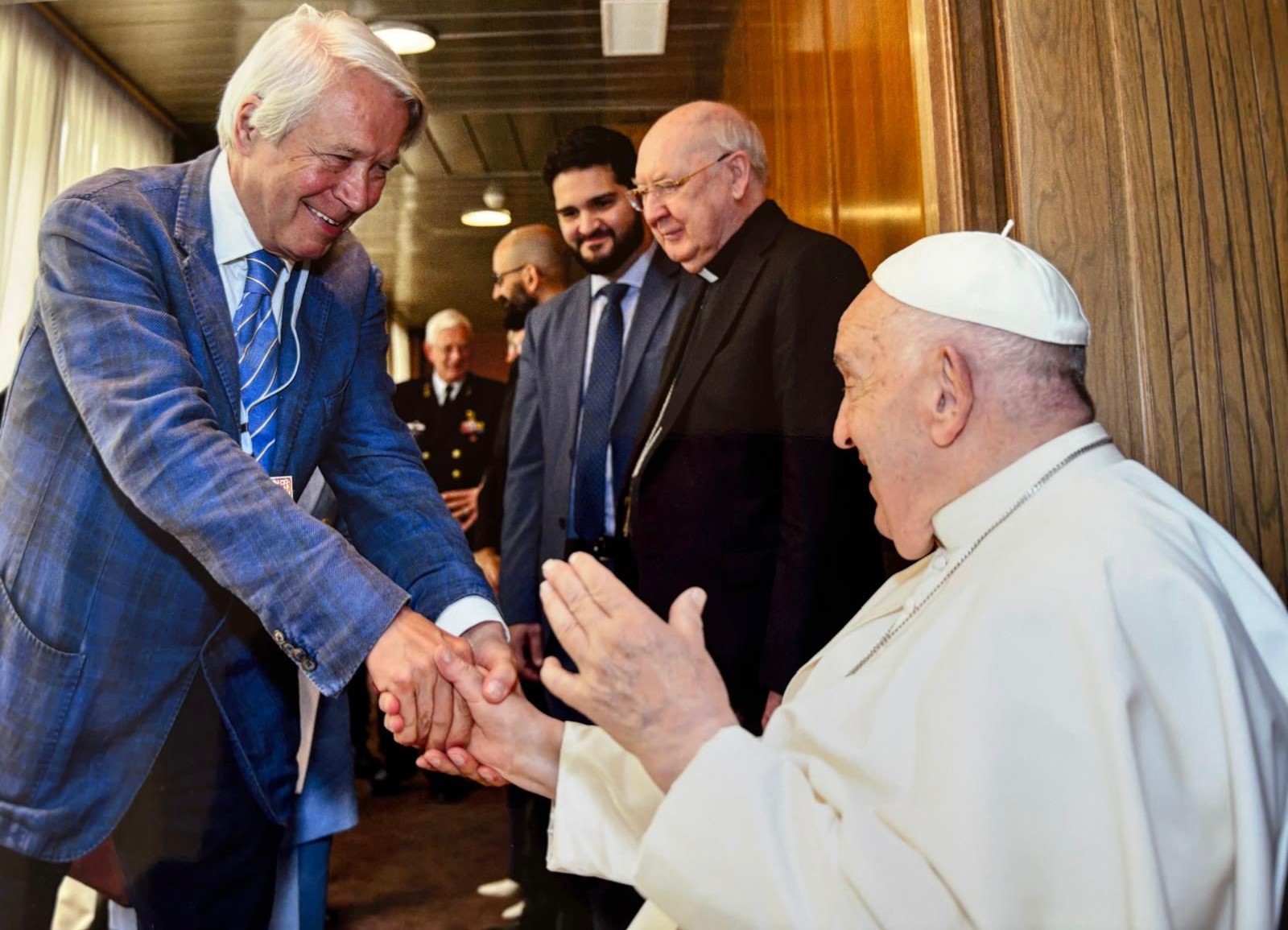
In the photos: The Holy Father meets the Ecclesiastical Assistant and the President of UMEC-WUCT, Archbishop Dollmann and prof. De Groof