Visualizzazione post con etichetta war. Mostra tutti i post

venerdì 19 dicembre 2025

WORLD DAY OF PEACE


Messaggio del Santo Padre Leone XIV per la LIX Giornata Mondiale della Pace [1° gennaio 2026]

[AR - DE - EN - ES - FR - IT - PL - PT - RU - UK]


 Pope Leo calls for an unarmed peace amid the threat of war

In his Message for the 2026 World Day of Peace, Pope Leo XIV addresses the escalation of war, rearmament and fear in international relations, and reiterates the Church’s opposition to deterrence based on military force. He calls for disarmament, dialogue and the conversion of hearts as necessary conditions for a lasting and unarmed peace.

By Linda Bordoni

As the Church observes the World Day of Peace on 1 January, Pope Leo XIV reflects on a world marked by fear, militarization and the threat of war. In his first Message for this observance, he addresses the seriousness of the moment while proposing a vision of peace that is “unarmed and disarming,” resisting violence not through force but through moral clarity, dialogue and the conversion of hearts.

“Peace be with you!”—the greeting of the Risen Christ—stands at the centre of the Message. Pope Leo XIV writes that these words “do not merely desire peace, but truly bring about a lasting transformation in those who receive it,” affirming that Christian peace is active and disruptive in its refusal of violence.

Fear as the currency of War

Fear is a theme in the Pope’s reflection. He warns that when societies lose sight of peace as a lived reality, they accept narratives in which war appears inevitable, even necessary.

"It is no coincidence," the Pope continued, "that repeated calls to increase military spending, and the choices that follow, are presented by many government leaders as a justified response to external threats.  The idea of the deterrent power of military might, especially nuclear deterrence, is based on the irrationality of relations between nations, built not on law, justice and trust, but on fear and domination by force. "

This approach, he said, does not bring security but entrenches instability and perpetuates anxiety.

Quoting Saint John XXIII, Pope Leo XIV recalls how peoples today live “in the grip of constant fear,” aware that weapons capable of catastrophic destruction already exist, and that war could erupt “by some chance and unforeseen circumstance.” He cites concrete figures, noting that global military expenditure rose by 9.4 percent in 2024 alone, reaching $2.7 trillion - resources directed toward instruments of death rather than human development.

When war becomes “normal”

The Message highlights a shift in political and cultural attitudes, where preparedness for war is viewed as prudent and disarmament as naïve. Pope Leo XIV writes: “When peace is not a reality that is lived, cultivated and protected, then aggression spreads into domestic and public life.” He warns that this normalisation of confrontation dominates global politics, undermining diplomacy and international law.

“When peace is not a reality that is lived, cultivated and protected, then aggression spreads into domestic and public life.”

The Pope also addresses the role of emerging technologies, including artificial intelligence, in military decision-making. He calls this a “destructive betrayal of the legal and philosophical principles of humanism,” as machines increasingly assume responsibility for life-and-death choices, while economic interests drive rearmament.

The unarmed path of the Gospel

The Pope reiterates that the Gospel links peace and nonviolence. “The peace of the risen Jesus is unarmed,” he writes, “His was an unarmed struggle in the midst of concrete historical, political and social circumstances.”

He recalls the challenge faced even by the disciples: “Put your sword back into its sheath.” Christians, he notes, are called to recognise past complicity in violence and commit to prophetic witness.

In a world that equates strength with domination, goodness itself becomes “disarming.” Pope Leo XIV reflects: “Perhaps this is why God became a child,” pointing to the defenselessness of Bethlehem as a revelation of divine power.

“The peace of the risen Jesus is unarmed, His was an unarmed struggle in the midst of concrete historical, political and social circumstances.”

Integral disarmament: beginning from within

Drawing again on Saint John XXIII, the Pope stresses that disarmament must extend beyond the realm of weapons. “Unless this process of disarmament be thoroughgoing and complete, and reach people’s very souls, it is impossible to stop the arms race.”

He insists that fear must be addressed at its root through the renewal of minds and hearts, replacing suspicion with trust. True peace, he writes, “cannot consist in the possession of an equal supply of armaments but only in mutual trust.”

Religions, he adds, have a responsibility to avoid using faith to justify violence or war and instead to be “houses of peace,” where hostility is addressed through dialogue, justice and forgiveness.

“True peace cannot consist in the possession of an equal supply of armaments but only in mutual trust.”

A political and moral imperative

The Message also addresses public authority. Pope Leo XIV calls for a renewed commitment to diplomacy, mediation and international law, lamenting the erosion of treaties and the weakening of supranational institutions.

He highlights that peace is not a utopia but a choice - personal, communal and political. Quoting Pope Francis, he warns against narratives that present violence as inevitable, noting that such narratives are tools of domination.

Walking in the light

The Message concludes with a vision rooted in hope, recalling the biblical promise of swords turned into ploughshares. In the Jubilee of Hope, Pope Leo XIV invites humanity to begin a “disarmament of heart, mind and life,” trusting that God’s promises call for responsibility.

Peace, he writes, “exists; it wants to dwell within us.” The task is not to create it, but to welcome it - and to allow it “to disarm us.”

“Peace exists; it wants to dwell within us. The task is not to create it, but to welcome it, and to allow it to disarm us.”

 Vatican News 


venerdì 5 aprile 2024

GAZA. STOP WAR

IT - EN - FR - ES 
 Gesuiti: su Gaza non possiamo tacere

La dichiarazione della Compagnia di Gesù sulla situazione in Terra santa

Immagine

«Quasi sei mesi di guerra a Gaza e le armi non hanno taciuto. Noi, membri della Compagnia di Gesù, come tanti altri cattolici, cristiani, uomini e donne di tutte le fedi e non credenti, ci rifiutiamo di tacere».

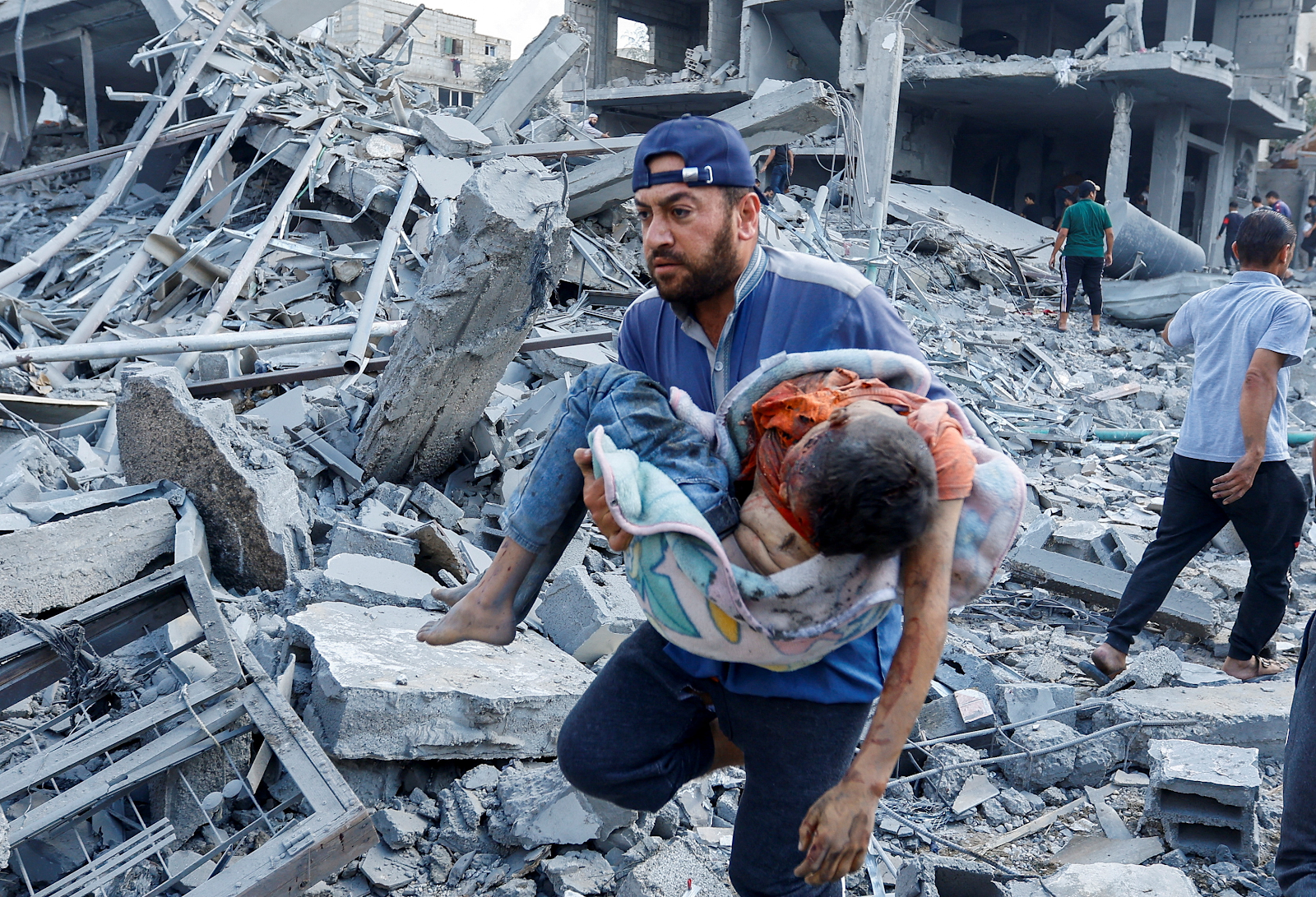
Venerdì 29 marzo i gesuiti hanno pubblicato una Dichiarazione riguardante la situazione di Gaza, in cui «dopo gli orrori degli attacchi nel sud di Israele del 7 ottobre 2023, i massicci bombardamenti israeliani sulla Striscia di Gaza, e l’offensiva di terra che ha lasciato la maggior parte della Striscia di Gaza in rovina», ribadiscono l’impegno a non rimanere in silenzio.

I gesuiti, impegnati da decenni nelle comunità e nelle società del Medio Oriente, considerano «inaccettabile che, nonostante vari tentativi, a quasi sei mesi dall’inizio dell’attuale conflitto, nessuno sia riuscito a fermare le uccisioni» e a «garantire che gli abitanti di Gaza abbiano cibo a sufficienza». E considerano «vergognoso che nessuno sia stato in grado di chiedere conto ai guerrafondai».

Per la Compagnia di Gesù «non è inevitabile che sia così»: l’orrore cui stiamo assistendo e che in troppi stanno vivendo sulla propria pelle è «una scelta e non un destino inalterabile».

I gesuiti rinnovano un «appello per un immediato cessate il fuoco, per il rilascio di tutti gli ostaggi del 7 ottobre, per un negoziato e per l’inizio di un processo che porti alla liberazione, alla libertà e alla giustizia per tutti in Medio Oriente, l’unica strada per la vera pace».

Il testo integrale della Dichiarazione.


NOUS NE POUVONS PAS RESTER SILENCIEUX !

Bientôt six mois de guerre à Gaza, et les armes ne se sont pas tues. Nous, les membres de la Compagnie de Jésus (les jésuites), comme tant d’autres catholiques, chrétiens, hommes et femmes de toutes confessions et non-croyants, refusons de nous taire. Nos voix continuent à s’élever en prière, en lamentations, en protestations contre la mort et la destruction qui continuent à régner à Gaza et dans d’autres territoires d’Israël/Palestine, et à se répandre dans les pays environnants du Proche-Orient.

Après les horreurs des attaques sur le sud d’Israël le 7 octobre 2023, les bombardements israéliens massifs sur la bande de Gaza et l’offensive terrestre qui a laissé la majeure partie de cette zone en ruines, nous assistons aujourd’hui à la famine et à la propagation de maladies à Gaza. Des dizaines de milliers de personnes sont mortes, près de 1.800 Israéliens, plus de 32.000 Palestiniens (sans compter ceux qui doivent encore être exhumés des décombres). En plus des vies fauchées, il y a des centaines de milliers de vies ruinées, de blessés, de sans-abri, de personnes affamées et atteintes par la maladie.

Les jésuites réitèrent leur engagement à ne pas rester silencieux. Il est inacceptable que, malgré les tentatives, près de six mois après le début de ce conflit, personne n’ait été en mesure d’arrêter les combats. Il est scandaleux que personne ne soit parvenu à obtenir que les habitants de Gaza mangent à leur faim. Il est honteux que personne n’ait pu demander de comptes aux belligérants. Malheureusement, nous constatons que la terre dite sainte est le théâtre d’un conflit qui se poursuit et qui s’envenime comme une plaie béante sur la face du Proche-Orient.

Engagés depuis des décennies parmi les communautés et les sociétés du Proche-Orient, les jésuites veulent dire qu’il n’est pas inévitable qu’il en soit ainsi. Le choix de la mort au détriment de la vie, de la vengeance au détriment de la réconciliation, de l’injustice au détriment de la justice, de l’intérêt personnel au détriment de la relation, de la violence au détriment du dialogue, est un choix et non pas une fatalité. D’autres choix sont possibles. Nous continuerons à nourrir le rêve d’un avenir différent, un avenir déjà prévu par les prophètes dans les Saintes Écritures. « De leurs épées, ils forgeront des socs, et de leurs lances, des faucilles. Jamais nation contre nation ne lèvera l’épée ; ils n’apprendront plus la guerre. » (Isaïe 2:4)

Nous joignons nos voix à celles du Saint-Père, le Pape François, qui a mis en garde à plusieurs reprises : « La guerre est une défaite ! Toute guerre est une défaite » (Angélus, 8 octobre 2023). Nous réitérons notre appel à un cessez-le-feu immédiat, à la libération des otages du 7 octobre, à des négociations et au lancement d’un processus qui assurera la liberté et la justice pour tous au Proche-Orient, seule voie vers une paix véritable.


WE CANNOT BE SILENT!

 Almost six months of war in Gaza, and the guns have not fallen silent. We, the members of the Society of Jesus (the Jesuits), like so many other Catholics, Christians, men and women of all faiths and non-believers, refuse to be silent. Our voices continue to be lifted up in prayer, in lament, in protest at the death and destruction that continue to reign in Gaza and other territories in Israel/Palestine, spilling over into the surrounding countries of the Middle East.

 ollowing the horrors of the attacks on southern Israel on 7 October 2023, the massive Israeli bombardments of the Gaza Strip, the ground offensive that has left most of the Gaza Strip in ruins, we are now witness to famine and the spread of disease in Gaza. Tens of thousands have died, almost 1,800 Israelis, over 32,000 Palestinians (not including those still to be unearthed from under the rubble). In addition to the lives snuffed out, there are hundreds of thousands of lives ruined, those who are wounded, homeless, and now hungry and smitten by disease.

 We, Jesuits, reiterate our commitment not to remain silent. It is unacceptable that, despite attempts, almost six months into the present round of conflict, no one has been able to stop the killing. It is scandalous that no one has been able to ensure that the residents of Gaza have enough to eat. It is shameful that no one has been able to call the warmongers to account. Sadly, we remember that an ongoing conflict in the land called to be holy has been allowed to continue and fester as an open wound on the face of the Middle East.

 Engaged for decades in the communities and societies of the Middle East, we, as Jesuits, want to say that it need not be this way. The choice of death over life, vengeance over reconciliation, wrongdoing over justice, self-interest over relationship, violence over dialogue is a choice and not fated destiny. There are other choices that could be made. We will continue to foster a dream of a different future, a future already foreseen by the prophets in the Holy Scriptures. “They shall beat their swords into plowshares, and their spears into pruning hooks; nation shall not lift up sword against nation, neither shall they learn war any more.” (Isaiah 2:4)

 We join our voice to that of the Holy Father, Pope Francis, who has repeatedly warned: “War is a defeat! Every war is a defeat” (Angelus, 8 October 2023). We repeat our call for an immediate ceasefire, for the release of all the 7 October hostages, for negotiations and for the beginning of a process that will bring freedom, liberty and justice for all in the Middle East, the only road to true peace.


¡NO PODEMOS CALLARNOS!

Casi seis meses de guerra en Gaza, y las armas no han callado. Nosotros, los miembros de la Compañía de Jesús (los jesuitas), como tantos otros católicos, cristianos, hombres y mujeres de todos los credos y no creyentes, nos negamos a callar. Nuestras voces siguen alzándose en oración, en lamento, en protesta por la muerte y la destrucción que siguen reinando en Gaza y otros territorios de Israel/Palestina, extendiéndose a los países vecinos de Oriente Medio.

Tras los horrores de los ataques sobre el sur de Israel el 7 de octubre de 2023, los bombardeos masivos israelíes sobre la Franja de Gaza, la ofensiva terrestre que ha dejado en ruinas la mayor parte de la Franja de Gaza, ahora somos testigos de la hambruna y la propagación de enfermedades en Gaza. Decenas de miles de personas han muerto, casi 1.800 israelíes, más de 32.000 palestinos (sin contar los que aún quedan por desenterrar de entre los escombros). Además de las vidas apagadas, hay cientos de miles de vidas arruinadas, heridos, personas sin hogar y ahora hambrientos y golpeados por la enfermedad.

Nosotros, jesuitas, reiteramos nuestro compromiso de no permanecer en silencio. Es inaceptable que, a pesar de los intentos, casi seis meses después de la actual ronda de conflicto, nadie haya sido capaz de detener la matanza. Es escandaloso que nadie haya sido capaz de garantizar que los residentes de Gaza tengan suficiente para comer. Es vergonzoso que nadie haya sido capaz de pedir cuentas a los belicistas. Tristemente, recordamos que se ha permitido que un conflicto en curso en la tierra llamada a ser santa continúe y supure como una herida abierta en la faz de Oriente Medio.

Comprometidos durante décadas en las comunidades y sociedades de Oriente Medio, nosotros, como jesuitas, queremos decir que no tiene por qué ser así. La elección de la muerte sobre la vida, de la venganza sobre la reconciliación, de la injusticia sobre la justicia, del interés propio sobre la relación, de la violencia sobre el diálogo, es una elección y no un destino predestinado. Se pueden hacer otras opciones. Seguiremos fomentando el sueño de un futuro diferente, un futuro ya previsto por los profetas en las Sagradas Escrituras. “Convertirán sus espadas en rejas de arado, y sus lanzas en podaderas; no alzará espada nación contra nación, ni se adiestrarán más para la guerra.” (Isaías 2,4)

Unimos nuestra voz a la del Santo Padre, el Papa Francisco, que ha advertido en repetidas ocasiones: “¡La guerra es una derrota! Toda guerra es una derrota” (Angelus, 8 de octubre de 2023). Reiteramos nuestro llamamiento a un alto el fuego inmediato, a la liberación de todos los rehenes del 7 de octubre, a las negociaciones y al inicio de un proceso que traiga liberación, libertad y justicia para todos en Oriente Medio, el único camino hacia la verdadera paz.

STOP WAR


martedì 26 marzo 2024

GAZA, INTOLERABLE SITUATION


Patriarch Pizzaballa:

 Situation in Gaza 

is intolerable

Speaking to an Italian television station, the Latin Patriarch of Jerusalem, Cardinal Pierbattista Pizzaballa, says that “everyone must do everything possible to put an end to this situation."

By Vatican News

"It is objectively intolerable."

That’s how Cardinal Gianbattista Pizzaballa, the Latin Patriarch of Jerusalem, described the situation in Gaza in a recent interview with the Italian television station TV2000.

“We have always had many problems of all kinds,” he continued, “and even the economic-financial situation has always been very fragile, but there has never been hunger before."

"Everyone—religious, political, and social communities," said Patriarch Pizzaballa, "must do everything possible to put an end this situation."

"The weakness of the United States," emphasised the Patriarch, "creates a great dilemma, because, until now, there has always been someone to put things in order. Now there is no longer anyone to play this role, and we have to do it ourselves. I don't know if, how, or when this will be possible."

Easter in times of war

Speaking days before the beginning of Holy Week, Patriarch Pizzaballa offered his reassurances that permits will be granted to Christians living in Palestinian territories to allow them to visit Jerusalem for liturgies.

"We’ll get the permits," he said. "We insisted, saying that as they had given permits to Muslims for Ramadan, they should also give them to Christians for Easter. Even if the numbers are smaller, we will have several thousand permits both for Palm Sunday and for Easter."

"It will be a difficult Easter," Cardinal Pizzaballa concluded. "I think of the loneliness of Jesus in Gethsemane, which is now shared by all of us."


 Vatican News


venerdì 15 dicembre 2023

ARTIFICIAL INTELLIGENCE AND PEACE


 In World Peace Day message, 

Pope warns of risks of AI for peace

In his message for the 57th World Day of Peace, Pope Francis reflects on the impact of Artificial Intelligence on world peace and urges the international community to adopt a binding international treaty that regulates its development and use.


AR  - DE  - EN  - ES  - FR  - IT  - PL  - PT  - RU


By Lisa Zengarini

 New technologies must always be directed to “the pursuit of peace and the common good, in the service of the integral development of individuals and communities.”

 In his annual Message for the World Day of Peace, Pope Francis urges world leaders to ensure that progress in developing forms of artificial intelligence “will ultimately serve the cause of human fraternity and peace.”

 The message, dedicated to the theme ‘Artificial Intelligence and Peace,’ was released by the Vatican on Thursday ahead of the 57th World Day of Peace, 1 January 2024.

 Inherent ambivalence of techno-scientific advances

In it, Pope Francis draws attention to the “ethical dimension “of these new technologies which are revolutionizing humanity in all spheres of life, highlighting the ambivalence inherent in any progress in science and technology.

 On the one hand, he says, it can lead to the betterment of humanity and the transformation of the world if it “contributes to greater order in human society and greater fraternal communion and freedom”

 On the other hand, techno-scientific advances, especially in the digital sphere, “are placing in human hands a vast array of options, including some that may pose a risk to our survival and endanger our common home.”

 No technological innovation is “neutral”

The message recalls that no scientific research and technological innovation is “neutral”: “As fully human activities, the directions they take reflect choices conditioned by personal, social, and cultural values in any given age. The same must be said of the results they produce: precisely as the fruit of specifically human ways of approaching the world around us, the latter always have an ethical dimension, closely linked to decisions made by those who design their experimentation and direct their production towards particular objectives.”

 This also applies to AI, for “the impact of any artificial intelligence device – regardless of its underlying technology – depends not only on its technical design, but also on the aims and interests of its owners and developers, and on the situations in which it will be employed.”

 Therefore, we “cannot presume a priori that its development will make a beneficial contribution to the future of humanity and to peace among peoples.  That positive outcome will only be achieved if we show ourselves capable of acting responsibly and respect such fundamental human values as ‘inclusion, transparency, security, equity, privacy and reliability’”, Pope Francis writes.

 Ethical issues

Hence the need, “to establish bodies charged with examining the ethical issues arising in this field and protecting the rights of those who employ forms of artificial intelligence or are affected by them.”

 “We have a duty to broaden our gaze and to direct techno-scientific research towards the pursuit of peace and the common good, in the service of the integral development of individuals and communities.”

 “Technological developments that do not lead to an improvement in the quality of life of all humanity, but on the contrary aggravate inequalities and conflicts, can never count as true progress,” the Pope says.

 The message goes on to highlight the many challenges posed by AI which are “anthropological, educational, social and political.”

 Risks for democratic societies

The ability of certain devices to produce coherent texts, for example, “is no guarantee of their reliability.” This, the Pope says, “poses a serious problem when artificial intelligence is deployed in campaigns of disinformation that spread false news and lead to a growing distrust of the communications media.”

 The misuse of these technologies can also have other negative consequences “such as discrimination, interference in elections, the rise of a surveillance society, digital exclusion and the exacerbation of an individualism increasingly disconnected from society”, all of which are threats to world peace.

 Pope Francis then warns of the risks to democratic societies and peaceful coexistence of the dominant technocratic paradigm behind AI and the cult of unlimited human power: “By proposing to overcome every limit through technology, in an obsessive desire to control everything, we risk losing control over ourselves.”

 Algorithms must not determine how we understand human rights

He insists on the “burning” ethical issues posed by AI, including discrimination, manipulation, or social control: “Reliance on automatic processes that categorize individuals, for instance, by the pervasive use of surveillance or the adoption of social credit systems, could likewise have profound repercussions on the social fabric by establishing a ranking among citizens.”

 “Algorithms must not be allowed to determine how we understand human rights, to set aside the essential human values of compassion, mercy, and forgiveness”, the Pope stresses, also highlighting the impact of new technologies on the workplace.

 Weaponization of artificial intelligence

Pope Francis expresses particular concern for the “weaponization of artificial intelligence,” citing Lethal Autonomous Weapon Systems (LAWS), drawing attention to the risk of sophisticated weapons ending up in the hands of terrorists.

 “The most advanced technological applications should not be employed to facilitate the violent resolution of conflicts, but rather to pave the way for peace.”

 On the positive side, Pope Francis notes that artificial intelligence can be used to promote integral human development, by introducing “important innovations in agriculture, education, and culture, an improved level of life for entire nations and peoples, and the growth of human fraternity and social friendship.”

 Challenges for education

The message goes on to highlight the challenges posed by AI to the education of the new generations who are growing up “in cultural environments pervaded by technology.”

 In this regard, the Pope points to the urgent need to educate young people in the use of artificial intelligence. This education, he says, “should aim above all at promoting critical thinking.”

 Need for an international treaty to regulate AI

Pope Francis therefore urges the global community of nations to work together to adopt a binding international treaty that regulates the development and use of artificial intelligence in its many forms: “The global scale of artificial intelligence makes it clear that, alongside the responsibility of sovereign states to regulate its use internally, international organizations can play a decisive role in reaching multilateral agreements and coordinating their application and enforcement.”

 “It is my prayer at the start of the New Year” the message concludes, “that the rapid development of forms of artificial intelligence will not increase cases of inequality and injustice all too present in today’s world but will help put an end to wars and conflicts and alleviate many forms of suffering that afflict our human family.”  

 Vatican News


MESSAGE OF HIS HOLINESS POPE
FRANCIS

AR  - DE  - EN  - ES  - FR  - IT  - PL  - PT  - RU


domenica 12 novembre 2023

RUTHLESS LOGIC

The problems created by the violence 
of Hamas and the harshness of Israel


- by Giuseppe Savagnone*

Just over a month after the start of the Palestinian crisis, some disturbing issues emerge, probably destined to weigh on the future, even when the conflict on the field is over.

The first of these issues arises from the methods of reaction of the Jewish State which, from being a victim of atrocious violence - and therefore an object of unconditional solidarity (in the eyes, at least, of the Western world) - have progressively made it appear, to a large extent of public opinion in the West itself, a perfect counterpart, opposite and symmetrical, of its aggressors. In this regard, the front page headline of an Italian newspaper is significant: «Anti-terrorism begins. It's a lot like terrorism."

The same blind ruthlessness. The same absolute contempt for civilians and the international laws that protect them. With the blocking of vital supplies of water, electricity and medicines to two and a half million people, the peremptory injunction to almost half of them (more than a million!) to vacate their homes, lands and workplaces within 24 hours , and to move "elsewhere", the deadly indiscriminate bombings that destroyed civilian homes, hospitals, schools, churches, and killed ten thousand civilians, almost half of whom were women and children.

Rather than an operation aimed at preventing, in a defensive logic, other attacks, the Israeli one thus gave the impression of being revenge. And not in the form of "an eye for an eye, a tooth for a tooth", but in the more archaic form of vengeance without measure of which the Bible speaks, putting in the mouth of Lamech, descendant of Cain (not by chance!), a statement which is at the same time a program: «I killed a man for my scratch and a boy for my bruise. Cain will be avenged seven times, but Lamech seventy-seven times" (Genesis, 4, 23-24).

 The law of retaliation

The law of retaliation, despite its brutality, was later established in ancient legislation precisely to limit this uncontrollable immoderation, allowing the offended party to respond only within the limits of the damage received.

Israel's response, more than this logic, resembles that of Lamech . Even more disproportionate, if we consider that, according to the Israeli government itself, the person responsible to be punished is Hamas and not the Palestinian population, who would only be its hostage.

For their part, Western governments, first and foremost that of the United States, refused to talk about "revenge" and initially tried to justify this reaction by appealing to "Israel's right to defend itself". In this logic, they showed great tolerance for the "collateral damage" that this right could entail, limiting themselves to generic recommendations to respect human rights and international laws of war, even if it was clear that both were widely violated by the Israeli reaction.

Netaniahu 's government did not intend to even slightly mitigate its devastating action, the UN secretary general, Guterres, officially intervened to remind us of the need to respect international law and ask for a "ceasefire ” that would spare the lives of civilians.

The reaction of the Jewish State was extremely harsh and even resulted in a refusal to grant entry visas to representatives of the United Nations.

At this point even President Biden - probably also urged by the vast protest movement that has developed throughout the Western world, and also in the United States, in defense of the Palestinian people - felt he had to intervene more decisively, pressuring the Israeli government so that at least "humanitarian pauses" were granted.

Receiving a sharp refusal from Prime Minister Netaniahu , who only after endless humiliating insistence from both the American president and his envoy Blinken made some concessions, but in any case to a minimal extent compared to the request. A sensational "disgrace" by Israel to its most trusted and important ally, which will not soon be forgotten.

 It is clear that all this is confusing the cards. The United States is finding itself in great difficulty, caught between the distancing of the Islamic world - even the moderate one and even a NATO member country, such as Turkey - which reproaches them for the political, economic and military cover that has always been given to Israel and strongly confirmed also in this circumstance, and the unprecedented, obstinate closure of the Israeli government.

In this circumstance, America is seeing its image as a hegemonic power compromised and its political line appears weak and uncertain. Also because President Biden finds himself faced with the less than rosy situation of having to choose, a year before the elections, between the Jewish lobbies, whose support depends on their support for Israel, and his electorate, especially young people, who contest him for this support.

And Israel also finds itself increasingly isolated, not only, as in the past, with respect to the South of the world and Islam, but also, to a certain extent, with respect to its traditional Western supporters, which continue to repeat that they consider it the victim of aggression and an advanced outpost of democracy, but they cannot help but recognize, with growing embarrassment, that the continuation of the systematic massacre of civilians we are witnessing can no longer be accepted.

 The reopening of the question of the whole of Palestine

But what divides Israel from its more traditional and faithful American ally is not only the ruthless harshness of the military reaction. The ongoing crisis has also raised the question, which had been removed for some time, of the definitive political settlement of the entire region. And here it is impossible to ignore the UN resolution of 1947, which envisaged the creation of a Jewish state - which was born - and a Palestinian one, which never saw the light.

The problem is that in reality neither Israelis nor Palestinians have ever accepted this perspective. Both want all the territory for themselves. With the difference that Israel has had the military strength to get ever closer to this objective, while the explicit refusal of the Palestinians to accept forming their own state on the territories assigned by the UN has produced as the only result their progressive expulsion even from most of these, now occupied by the Israelis.

An expulsion that was implemented both through military campaigns and with the multiplication of new Israeli settlements on the lands of the West Bank which should have prospectively been part of the new Palestinian state. Just on the eve of October 7th, another one was launched, this time also arousing resistance (also unheeded) from the United States.

Not to mention the status of Jerusalem, which the UN expected to be - as the holy place of all three great Abrahamic religions - an international city, and which instead Israel, in 1980, strengthened by its military successes, unilaterally proclaimed as its capital , with a decision that the UN declared illegitimate, and which was recognized by a few governments, including the United States, which moved its embassy there,

Once the war is over, will Washington, so far so yielding to the Israeli government, ever be able to convince it to give up part of its current territory to allow the formation of a Palestinian state?

And what will be, if they succeed, the reaction of the seven hundred thousand Israeli settlers who in recent years, with the approval of the government (and the West) have illegally settled on that territory, taking it away from their legitimate inhabitants?

And what will happen to Jerusalem, which Israel has considered its capital for more than forty years, but where Palestinians also live, and to which Islam attributes the same religious value as Jews and Christians?

 The future of Gaza

A third issue - connected to the second and also relating to the relationship between Israel and the United States - is the question of the future of the Gaza Strip.

 Biden asked Abu Mazen, the president of the Palestinian National Authority in the West Bank, to take over the government, once the war is over, as part of the forming Palestinian state. Netaniahu , for his part, openly challenging Biden, replied that the Israelis no longer intend to leave Gaza any autonomy and, even without directly occupying it, they will still keep it under their control.

The fact is that, if it really succeeds in destroying Hamas, it will be the Israeli army that will be on the territory and in control of it.

Furthermore, the American proposal does not take into account the fact that today the (too) moderate and corrupt Abu Mazen is completely disqualified in the eyes of the Palestinians (even those he continues to govern in the West Bank), who see Hamas as the the only alternative to the marginalization and submission to which Israel had reduced them with the support of the United States.

And it would certainly be even more so if the president of the Palestinian Authority entered Gaza after having been complicit in the liquidation of Hamas by the Israelis and with the support of the Americans.

An unofficial and unconfirmed document from the Israeli government hypothesizes that the current inhabitants of Gaza will move to Egypt, in the Sinai. And this would also explain the recent trials of expulsion from one part of the Strip and the actions aimed at making their lives impossible, already forcing them, in some way, to emigrate.

But, apart from the obvious resistance of the government in Cairo, which does not intend to take on two and a half million refugees, could the international community accept a solution which, although not a genocide, would still be a clear example of ethnic cleansing?

Not even the acrobatics carried out in recent weeks by Western governments and press organizations to minimize the seriousness of the violence against the Palestinian people - accusing those who denounce them of forgetting the October 7 massacre, or even of being anti-Semitic - would probably be sufficient to justify the silence in such a hypothesis.

However, the difficulty of finding other ways remains. The task cannot be avoided once again. The West cannot continue to turn a blind eye, now that it is reaping the bitter fruits of this behavior in past decades. Even if there is the risk that, once the journalistic news has passed, the attention of governments and public opinion will go back to being distracted, as has always happened in the past, waiting for another crisis to cause thousands more innocent victims and shake the new, for a few weeks, our indifference.

 www.tuttavia.eu

 *Writer and columnist. Pastoral Care of Culture of the Diocese of Palermo


martedì 17 ottobre 2023

THE RIGHT OF ISRAEL


 - by Giuseppe Savagnone*


  Just a group of terrorists?

 In the face of the savage violence of Hamas's attack on Israel, the horror and unconditional solidarity of almost the entire Western world appear fully justified. A solidarity that immediately extended to the Jewish state's reactions to its attackers. 'Israel has the right to defend itself', was the phrase that resounded on the lips of politicians, of intellectuals, and which Pope Francis also made his own.

  There is, however, something unsaid in this incontrovertible statement that should be clarified, and that concerns the recipients and modalities of this defensive action.

  "We will crush terrorists, like Isis," Netanyahu promised. The question, however, is whether we are really only in front of a group of terrorists, of whom the two million people living in the Gaza Strip, controlled by Hamas (one million two hundred thousand are Palestinian refugees) would be "hostages", as Giuliano Ferrara claimed at the torchlight procession for Israel.

  In reality, the recent history of Gaza strongly casts doubt on this narrative. The Israelis (who in 1967 had wrested it from Egypt in the 'six-day war') withdrew in 2005, leaving it under the control of the Palestinian National Authority, with which the Tel Aviv government, in the Oslo accords, had made a pact back in 1993. But in the elections held the following year, in 2006, it was not this more moderate fringe that won, but the extremist Islamic movement of Hamas, which has been in power ever since.

  An outcome due to the growing discredit of the Palestinian Authority, which, under the leadership of the former President Abu Mazen, has long since lost all determination in claiming the rights of the Palestinian people and is increasingly drowning in corruption. So much so that today, even in the West Bank, the other territory of Palestine where Abu Mazen is still in power, he has avoided calling new elections for years because all the polls predict, should they take place, the sure victory of Hamas.

  Not even in Gaza, in fact, have there been new elections since 2006. And it is certainly not a liberal regime, as demonstrated by the systematic repression of women's rights - along the same lines as Iran, the Shiite Islamic state to which Hamas is closest - and of all opponents in general.

  A people of despair

 But to rally behind its government the people of the Strip came to the rescue, against its own intentions, precisely Israel which, in reaction to the 2006 election results, imposed a total embargo on the region, with a suffocating control of people and goods entering or leaving, leading to a disheartening condition of dependence and a further impoverishment of the inhabitants.

  The International Red Cross declared the illegality of this policy, which entailed 'collective punishment for the people living in the Gaza Strip' - two million human beings -, turning it into what the non-governmental organisation Human Rights Watch called 'an open-air prison' last year, but to no avail.

  Thus, social anger - exasperated by these ruthless measures and the Palestinian Authority's culpable inertia - pushed the new generations into the arms of Hamas, which ended up expressing the despair of a hopeless people. In the end, today it is this people that is the real target of Israel's 'defence' action.

  It is, after all, also for logistical reasons. 'We must liberate Gaza even with bombs, even with tanks, even with the army', Giuliano Ferrara shouted to roaring applause in his fiery speech.

  But in a territory that is among the most densely populated in the world, with two million people crammed into an area of 360 square kilometres, the bombs are inevitably destined to hit mostly civilians. The toll of six days of air raids on the Strip is more than 1,500 dead, including 500 children.

  So it was with the embargo imposed by Israel in 2007. So it is now for the total blockade of fuel, water and light with which the Jewish State has responded to the Hamas attack. It is not only the 'terrorists' who are suffering, but the poor people, men, women and children, who are at the point of exhaustion. Even hospitals report that they can no longer operate their equipment, starting with operating theatres and incubators to save the lives of newborn babies, without electricity.

  It is strange that so many acute Western observers - journalists, political personalities, intellectuals - rightly horrified at the 'slaughter of the innocent' perpetrated by Hamas, have nothing to object, indeed in many cases applaud, this massacre of Palestinian children and women.

On this line of ruthless violence towards the population is also the latest order given by the Israeli military command, which ordered the evacuation within 24 hours of the north of the Strip. In this way, the poor people of this area - one million human beings, many of whom had already been driven out of their land, taken by the Israelis, and were living there as refugees - are forced, from one day to the next, to abandon their homes, their poor jobs, their world.

  A counter-terrorism that looks like terrorism

 But with this we are also faced with the answer to the second question, that of how. A few days ago, an out-of-the-blue newspaper headlined: 'Counter-terrorism is triggered. It looks a lot like terrorism'. Where the difference between war and terrorism is that the former is still subject to rules, established internationally, and targets enemy military personnel in order to destroy them, while the latter has no rules and, rather than defeating an army, aims to terrorise the civilian population.

  Now, in reality, this is the tactic of Hamas, which certainly cannot compete with Israel's military apparatus, but - as it did in the last attack - aims to strike the adversary by sowing fear. However, the tactics of the Jewish State are also very similar to this, as it knows full well that it cannot strike at the heart of the Hamas fighters - protected by a network of 45 km of fortified underground tunnels - with its air raids, but inflicts on the Palestinian population, in addition to the bombs, a series of hardships and inconveniences, in the hope (which has turned out to be fallacious, as we saw earlier) of detaching it from the armed organisation, without realising that it is playing its own game.

  Also part of this style is the Israeli air force's use of weapons banned by international conventions, such as white phosphorus bombs, which are banned by international conventions because they cause terrible burns and, in those who survive, serious illnesses.

  If the Jewish children burned by Hamas arouse our horror, no less so does the thought that there are so many Palestinians suffering the same fate these days. A tragic symmetry of monstrosities, which, absurdly, is not reflected in the assessments of Western public opinion, rightly shocked by the former, strangely insensitive to the latter.

 The importance of memory

 But the dramatic events of these days must be understood in the light of a history, which certainly cannot be invoked to mitigate the absolute condemnation of the atrocities committed by Hamas, even if it helps to understand their origin.

 A history that begins in 1947, when a United Nations General Assembly resolution established the constitution and coexistence of a Jewish and a Palestinian state. Jerusalem was to be an international zone.

 Although neither Palestinians nor Israelis ever accepted this partition, the former because they felt robbed of a land they had inhabited for almost two thousand years and from which they were now driven out, the latter because they saw in it the possibility of a return to their origins and wanted it all.

 In reality, more than seventy-five years later, that resolution remains unfulfilled. The Palestinian state never came into being and the territories that should have been itss, according to the UN resolution, are illegally occupied by Israel, except for the Gaza Strip and part of the West Bank, which do not even have territorial continuity. As for Jerusalem, it was proclaimed capital of Israel in 1980.

  What is more, in the territories that still remain to the Palestinians and are under its control, the Israeli government has in recent years multiplied new settlements of settlers, further violating the UN resolution.

  Since 2002, then, the Israeli government, in a decision condemned by the Court of Justice and the European Union, erected a fortified wall more than 300 km long separating the most important Palestinian territories in the West Bank from Israel, separating families and communities living and working on either side of the wall.

  The United Nations has explicitly declared these obvious prevarications illegal on several occasions, but neither Israel nor its allies - first and foremost the United States - took any notice of them.

  Lately, then, President Netanyahu - grappling with heavy accusations of corruption and needing, in order to escape prosecution, to strengthen the consensus of the extreme right, has endorsed others, this time going against the advice even of President Biden, who vainly tried to dissuade him. Then the deluge. Which, however, as should be clear, did not come 'out of the blue'.

To fight monsters

'The sleep of reason breeds monsters', wrote Goya. On both sides, many have been unleashed in this ruthless conflict, with appalling human costs. One does not solve the problem by erasing memory and reducing everything, as one tries to do, to a phenomenon of 'terrorism'.

  Hamas is not Isis, because it has behind it a people whose rights have been recognised by the UN and systematically trampled upon.

 In turn, one cannot claim to start, as Hamas does, from the premise that Israel has no right to exist. Only a mutual recognition - which for a moment seemed to have been achieved in Oslo - can constitute a real solution.

  It is necessary to strengthen, on both the Israeli and the Palestinian side, the fringes - which do exist - of reasonable people capable of reopening dialogue. Any justification of inhuman behaviour, on either side, is a favour done to the monster party.

  *Writer and Editorialist. Responsible for the website of the Pastoral Care of Culture of the Archdiocese of Palermo, www.tuttavia.eu