domenica 12 novembre 2023

UMEC-WUCT A' L'UNESCO - UMEC-WUCT AT UNESCO


 42Eme CONFERENCE GENERALE  DE L’UNESCO

PRISE DE PAROLE

 DE L’UMEC – WUCT A L’UNESCO

 fr - en 

Intervention de P. Albert Kabuge, délégué de l’UMEC-WUCT près de l’UNESCO

11 novembre 2023

En pleine session de la 42ème Conférence Générale qui se tient à Paris du 07 au 22 Novembre 2023 basée sur l’Education et la Paix, UMEC-WUCT a eu l’occasion de prendre la parole en ce 11 novembre 2023 au Siège de l’UNESCO à Paris. Au nom de notre organisation, le Père Albert Kabuge a pu s’exprimer devant l’auguste assemblée. Nous vous présentons une partie de cette prise de parole.

 Son Excellence la Directrice Générale de l’UNESCO, madame Audray Azoulay,

Chère madame la Présidente de la 42ème conférence générale de l’UNESCO,

Cher Président du comité de liaison des ONG avec UNESCO, Monsieur Nick Newland

  Nous collaborons avec le Saint-Siège, l’UNESCO, nous sommes membres du CCIC « Centre Catholique International de Coopération avec l’UNESCO » et avec d’autres organisations qui ont pour mission la formation intégrale de la personne, et des enseignants qui travaillent dans les écoles les universités catholiques et laïques. Nous encourageons la solidarité, le dialogue entre les enseignants, entre les institutions éducatives. Nous visons la formation à la citoyenneté mondiale.

 Dans l’esprit de l’UNESCO notre organisation dans des moments durs qu’a vécu la société, le monde surtout en période de Covid-19, nous avons essayé de rendre la science intelligible dans nos milieux surtout avec le numérique pour organiser les activités avec créativité pour marcher dans cet esprit de construire une paix durable dans notre réseau et ailleurs par les conférences en lignes, les actions d’assistance matérielle aux enfants en difficulté dans les périphéries de nos villes.

 Chers membres de Conférence Générale, nous tenons à notre collaboration avec l’UNESCO et avec le comité de liaison des ONG dans le secteur de l’Education des jeunes, dans l’Enseignement, et que nous puissions mener des projets ensemble pour une paix durable et permanente et nous encourageons les différents représentant des Régions à collaborer avec l’UNESCO au niveau local et au niveau mondial.

 Nous tenons à ce que nous puissions connaître les textes officiels ou les directives qui structurent les domaines de travail de l’UNESCO. Ainsi nous avons participé aux rencontres de la révision de la recommandation de 1974 sur l’éducation, la nouvelle mouture devient une occasion unique de raviver et d'actualiser le consensus mondial autour du rôle de l'éducation sous toutes ses formes.  Nous avons participé au concours du prix Felix Houphouët Boigny sur la Paix, aux travaux sur le leadership féminin, sans oublier les rencontres de webinaire organisées par le comité de liaison des ONG et l’UNESCO.

« Nul n’ignore que l’éducation transforme la vie, elle est un droit pour chacun tout au long de la vie. Acceptons de nous rassembler autour de l’avenir de l’éducation, il est temps de repenser notre style d’éducation dans ce monde qui change. »

Malgré les conflits, nous sommes appelés comme membres de l’UMEC-WUCT à continuer sur ce domaine de l’éducation qui est un domaine important pour nous et pour UNESCO.

  Nous encourageons nos représentants qui sont à Paris à continuer à être présents dans ces rencontres qui enrichissent notre famille dans le domaine de l’éducation. C’est en se côtoyant qu’on se connaît mieux et apprend des autres dans le domaine de l’éducation et de la construction de la paix. Ensemble éduquons à la paix les responsables de demain dans le présent.


 42nd UNESCO GENERAL CONFERENCE

UMEC – WUCT SPEAK AT UNESCO

 In the middle of the session of the 42nd General Conference which is being held in Paris from November 7 to 22, 2023 based on Education and Peace, UMEC-WUCT had the opportunity to speak on November 11, 2023 at the Headquarters of the UNESCO in Paris. On behalf of our organization, Father Albert Kabuge was able to speak before the august assembly. We present part of this speech to you.


Her Excellency the Director General of UNESCO, Ms. Audray Azoulay,

Dear Madam President of the 42nd General Conference of UNESCO,

Dear Chairman of the NGO Liaison Committee with UNESCO, Mr Nick Newland

   We collaborate with the Holy See, UNESCO, we are members of the CCIC “International Catholic Center for Cooperation with UNESCO” and with other organizations whose mission is the integral formation of the person, and of teachers who work in schools, Catholic and secular universities. We encourage solidarity, dialogue between teachers, between educational institutions. We aim for training in global citizenship.

 In the spirit of UNESCO, our organization in difficult times that society, the world has experienced, especially in the period of Covid-19, we have tried to make science intelligible in our environments, especially with digital technology to organize activities. with creativity to walk in this spirit of building lasting peace in our network and elsewhere through online conferences, actions of material assistance to children in difficulty in the outskirts of our cities.

 Dear members of the General Conference, we are keen on our collaboration with UNESCO and with the liaison committee of NGOs in the sector of Youth Education, in Teaching, and that we can carry out projects together for lasting peace and permanent and we encourage the various representatives of the Regions to collaborate with UNESCO at the local and global level.

 We want to know the official texts or directives that structure UNESCO's areas of work. Thus we participated in the meetings to revise the 1974 recommendation on education, the new version becomes a unique opportunity to revive and update the global consensus around the role of education in all its forms. We participated in the Felix Houphouët Boigny Peace Prize competition, in the work on women's leadership, without forgetting the webinar meetings organized by the NGO liaison committee and UNESCO.

“Everyone knows that education transforms life; it is a right for everyone throughout life. Let us agree to come together around the future of education, it is time to rethink our style of education in this changing world. »

Despite the conflicts, we are called as members of UMEC-WUCT to continue in this area of education which is an important area for us and for UNESCO.

   We encourage our representatives who are in Paris to continue to be present in these meetings which enrich our family in the field of education. It is by working alongside each other that we know each other better and learn from others in the field of education and peacebuilding. Together, let's educate the leaders of tomorrow in peace in the present.


Fr. Albert Kabuge et Mme Christine Roche, 
délegué de l'UMEC-WUCT prés de l'UNESCO


ÉDUQUER, C'EST HUMANISER

 Protéger le droit des parents 

d'éduquer leurs enfants en toute liberté


Le Pape a rencontré une centaine de participants à l’assemblée générale de l’association européenne des parents, samedi 11 novembre, en salle du Consistoire au Palais apostolique. Devant cette organisation représentant plus de 150 millions de parents du Vieux Continent, l’évêque de Rome a proposé une réflexion sur la vocation et la mission des parents dans une Europe en proie à tous les matérialismes et subjectivismes rendant ardue l’éducation des enfants.

Le Souverain pontife a d'emblée regretté que la mission éducative des parents ne soit pas favorisée aujourd'hui par le contexte culturel en Europe. Elle est marquée selon lui par « un subjectivisme éthique et un matérialisme pratique ». La dignité de la personne humaine est toujours affirmée mais parfois peu respectée, dénonce le Saint-Père, constatant le désarroi de parents se rendant vite compte que leurs enfants baignent dans cette atmosphère culturelle. « Ce qu'ils "respirent", ce qu'ils absorbent des médias, est souvent en contradiction avec ce qui était considéré comme "normal" il y a encore quelques décennies et qui semble ne plus l'être aujourd'hui», affirme le Successeur de Pierre.

Face aux difficultés « parfois décourageantes», le Pape prône donc «la passion de l'éducation» chez les parents. « Certes, la culture a changé, mais les besoins les plus profonds du cœur humain restent immuables et finissent tôt ou tard par se manifester chez les enfants. Nous devons toujours partir de là», encourage l’évêque de Rome, rappelant que Dieu lui-même a inscrit dans notre nature «les exigences irrépressibles de l'amour, de la vérité, de la beauté, de la relation et du don de soi, de l'ouverture au "toi" de l'autre et de l'ouverture au "toi" transcendant». Ces besoins du cœur sont des alliés puissants de tout éducateur, relève-t-il, assurant qu’en les faisant ainsi émerger, les enfants n'auront aucune difficulté à voir le bien.

 Découvrir la positivité fondamentale de l'existence

«La tâche de l'éducation peut être considérée comme réussie lorsque les enfants découvrent la positivité fondamentale de leur existence, de leur être dans le monde, et lorsque, forts de cette conviction, ils affrontent l'aventure de la vie avec confiance et courage, convaincus qu'ils ont eux aussi une mission à accomplir, une mission dans laquelle ils trouveront leur accomplissement et leur bonheur», détaille encore François, reliant cette mission «à l’amour de Dieu» à la racine.

 « Dieu lui-même a fait de moi un bon don et je suis un don pour mes proches et pour le monde, et tout le monde peut le dire. Cette certitude aide à ne pas vivre mû par une tendance dévalorisante à "s’économiser", dans le souci constant de se préserver, de ne pas trop s'impliquer, de ne pas se salir les mains. Il y a ces pièges...», observe le Pape, plaidant au contraire pour le fait de «perdre sa vie pour autrui». «La vie s'ouvre à toute sa richesse et à toute sa beauté lorsqu'elle est dépensée».

 C’est selon lui la grande tâche éducative des parents : former des personnes libres et généreuses qui ont connu l'amour de Dieu et qui donnent gratuitement ce qu'elles savent avoir reçu comme un don. La transmission de la gratuité n'est pas facile à transmettre, constate-t-il encore, reliant cet élément à l’ensemble de la société.

 Sans rôle social des parents, les enfants grandissent « comme des îles»

«C'est aussi là que se trouvent les racines d'une société saine. C'est pourquoi il est important que le rôle social des parents soit reconnu à tous les niveaux. Éduquer un enfant est un véritable travail social, car il s'agit de le former à la relation, au respect des autres, à la coopération en vue d'un objectif commun, de le former à la responsabilité, au sens du devoir, à la valeur du sacrifice pour le bien commun.»

 Sans cela, le Pape affirme que les enfants grandissent comme des "îles", déconnectés des autres, incapables d'une vision commune, habitués à considérer leurs propres désirs comme des valeurs absolues : «des enfants capricieux, mais cela se produit généralement lorsque les parents sont capricieux ! C'est ainsi que la société se déconstruit, s'appauvrit, s'affaiblit et devient de plus en plus inhumaine ».

 Liberté des parents face aux idéologies en milieu scolaire

Et le Pape d’exhorter à protéger le droit des parents d'élever et d'éduquer leurs enfants en toute liberté, sans être contraints, dans quelque domaine que ce soit, et en particulier dans l'environnement scolaire, d'accepter des programmes éducatifs qui sont en contradiction avec leurs croyances et leurs valeurs. « Il s'agit d'un très grand défi à l'heure actuelle», note-t-il, assurant aux familles que l’Église marche à leurs côtés.

 Le Pape a enfin rappelé la mise en place du « Pacte éducatif mondial » depuis 2019 et la création concomitante d’un «Pacte pour la famille» entre les acteurs culturels, académiques, institutionnels et pastoraux, pour mettre au centre la famille et ses relations: homme-femme, parents-enfants, liens fraternels. Le tout, pour surmonter certaines fractures qui affaiblissent actuellement les processus éducatifs : la fracture entre l'éducation et la transcendance, la fracture dans les relations interpersonnelles, la fracture qui éloigne la société de la famille, créant des inégalités et de nouvelles pauvretés.

 Vatican News

 DISCOURS DU PAPE

[EN - IT]


mercoledì 1 novembre 2023

CALLED TO SANCTITY - APPELÉS À LA SAINTETÉ - LLAMADOS A LA SANTIDAD - CHIAMATI ALLA SANTITA'

en - es - fr - it


A SHINING

 REFLECTION 

OF THE LORD 

IN HISTORY

 AND IN THE WORLD


Holiness is a gift - it is a gift, it cannot be bought - and at the same time it is a journey.

  "It is proper for holiness to attract. God calls us by attraction. God attracts and you have felt this grace of divine attraction....

Every Christian is called every day to commit himself with an undivided heart to the vocation and mission entrusted to him by God, serving Him and his neighbour in a spirit of charity....

Apostolic zeal implies both a union with Jesus, nourished by prayer and the Sacraments, and the desire to spread the beauty of the Christian message through fidelity to one's particular vocation...

We too, therefore, drawing strength from the Lord, learn to perform ordinary actions in an extraordinary way and thus grow each day in faith, charity and zealous witness to Christ. Each of us is called to holiness, to everyday holiness, to the holiness of the common Christian life.

Sometimes, by insisting too much on our own efforts to do good works, we have generated an ideal of holiness that is too much based on us, on personal heroism, on the ability to renounce, on sacrificing ourselves in order to win a prize. It is sometimes too Pelagian a vision of life, of holiness. Thus we have made holiness an impervious goal, we have separated it from everyday life instead of seeking it and embracing it in the everyday, in the dust of the road, in the travails of concrete life.

To be disciples of Jesus and to walk the path of holiness is above all to allow oneself to be transfigured by the power of God's love".

 Holiness is not made up of a few heroic gestures, but of daily love. To love means this: to serve and to give one's life. Serving, that is, not putting one's own interests first; detoxifying ourselves from the poisons of greed and competition; fighting the cancer of indifference and the canker of self-referentiality; sharing the charisms and gifts that God has given us. .... In concrete terms, ask 'what do I do for others?'

 This is loving, and living everyday things in a spirit of service, with love and without clamour, without claiming anything. And then giving one's life, which is not just offering something, such as some of one's own goods to others, but giving oneself

 The secret of holiness is to serve the Gospel and one's brothers and sisters, to offer one's life without return. This is how the saints have lived holiness: by enthusiastically embracing their vocation, they have spent themselves for the Gospel, they have discovered a joy that is unparalleled, and they have become shining reflections of the Lord in history.

 This is how saints have lived holiness: by enthusiastically embracing their vocation, they have spent themselves for the Gospel, they have discovered a joy that is unparalleled and they have become shining reflections of the Lord in history.

 This is what a saint is: a luminous reflection of the Lord in history.

 Let us continue on this path, the Lord will not fail us.

Pope Francis


 UN REFLEJO LUMINOSO DEL SEÑOR 

EN LA HISTORIA Y EN EL MUNDO

 La santidad es un don -no se puede comprar- y al mismo tiempo es un camino.

Es propio de la santidad atraer. Dios nos llama por atracción. Dios atrae y tú has sentido esta gracia de la atracción divina....

Todo cristiano está llamado cada día a comprometerse con corazón indiviso en la vocación y misión que Dios le ha confiado, sirviéndole a Él y al prójimo con espíritu de caridad....

El celo apostólico implica tanto la unión con Jesús, alimentada por la oración y los Sacramentos, como el deseo de difundir la belleza del mensaje cristiano mediante la fidelidad a la propia vocación particular...

Por tanto, también nosotros, tomando la fuerza del Señor, aprendemos a realizar las acciones ordinarias de modo extraordinario y así crecemos cada día en la fe, en la caridad y en el testimonio celoso de Cristo. Cada uno de nosotros está llamado a la santidad, a la santidad cotidiana, a la santidad de la vida cristiana común.

A veces, al insistir demasiado en nuestro esfuerzo por hacer buenas obras, hemos generado un ideal de santidad demasiado basado en nosotros, en el heroísmo personal, en la capacidad de renuncia, en sacrificarnos para ganar un premio. Es una visión a veces demasiado pelagiana de la vida, de la santidad. Así hemos hecho de la santidad una meta impermeable, la hemos separado de la vida cotidiana en lugar de buscarla y abrazarla en lo cotidiano, en el polvo del camino, en los afanes de la vida concreta.

Ser discípulos de Jesús y caminar por la senda de la santidad es, ante todo, dejarse transfigurar por la fuerza del amor de Dios".

 La santidad no está hecha de algunos gestos heroicos, sino del amor cotidiano. Amar significa esto: servir y dar la vida. Servir, es decir, no anteponer los propios intereses; desintoxicarse de los venenos de la codicia y la competencia; luchar contra el cáncer de la indiferencia y el cancro de la autorreferencialidad; compartir los carismas y dones que Dios nos ha dado. .... En concreto, pregúntate "¿qué hago yo por los demás?

 Esto es amar, y vivir lo cotidiano con espíritu de servicio, con amor y sin clamores, sin pretender nada. Y luego dar la vida, que no es sólo ofrecer algo, como algunos de los propios bienes a los demás, sino darse uno mismo...".

 El secreto de la santidad es servir al Evangelio y a los hermanos, ofrecer la propia vida sin contrapartida. Así han vivido los santos la santidad: abrazando con entusiasmo su vocación, se han gastado por el Evangelio, han descubierto una alegría inigualable y se han convertido en reflejos luminosos del Señor en la historia.

 Así han vivido los santos la santidad: abrazando con entusiasmo su vocación, se han gastado por el Evangelio, han descubierto una alegría sin igual y se han convertido en reflejos luminosos del Señor en la historia.

 Esto es un santo: un reflejo luminoso del Señor en la historia.

 Sigamos por este camino, el Señor no nos fallará.

Papa Francisco


 UN REFLET BRILLANT DU SEIGNEUR 

DANS L'HISTOIRE ET DANS LE MONDE

La sainteté est un don - elle ne s'achète pas - et en même temps un voyage.


  "Il est propre à la sainteté d'attirer. Dieu nous appelle par attraction. Dieu attire et vous avez ressenti cette grâce de l'attraction divine....

Chaque chrétien est appelé chaque jour à s'engager d'un cœur sans partage dans la vocation et la mission que Dieu lui a confiées, en le servant et en servant son prochain dans un esprit de charité....

Le zèle apostolique implique à la fois l'union avec Jésus, nourrie par la prière et les sacrements, et le désir de diffuser la beauté du message chrétien par la fidélité à sa vocation particulière...

Nous aussi, par conséquent, en puisant notre force dans le Seigneur, nous apprenons à accomplir des actions ordinaires de manière extraordinaire et nous grandissons ainsi chaque jour dans la foi, la charité et le témoignage zélé du Christ. Chacun de nous est appelé à la sainteté, à la sainteté quotidienne, à la sainteté de la vie chrétienne commune.

Parfois, en insistant trop sur nos propres efforts pour accomplir de bonnes œuvres, nous avons généré un idéal de sainteté qui repose trop sur nous, sur l'héroïsme personnel, sur la capacité de renoncer, sur le fait de se sacrifier pour gagner un prix. C'est parfois une vision trop pélagienne de la vie, de la sainteté. Ainsi, nous avons fait de la sainteté un objectif imperméable, nous l'avons séparée de la vie quotidienne au lieu de la rechercher et de l'embrasser dans le quotidien, dans la poussière de la route, dans les difficultés de la vie concrète.

Être disciples de Jésus et parcourir le chemin de la sainteté, c'est avant tout se laisser transfigurer par la puissance de l'amour de Dieu".

 La sainteté n'est pas faite de quelques gestes héroïques, mais d'un amour quotidien. Aimer signifie ceci : servir et donner sa vie. Servir, c'est-à-dire ne pas privilégier ses propres intérêts ; se désintoxiquer des poisons de l'avidité et de la compétition ; combattre le cancer de l'indifférence et le chancre de l'autoréférentialité ; partager les charismes et les dons que Dieu nous a donnés. .... Concrètement, posez-vous la question suivante : "Que fais-je pour les autres ?

 Il s'agit d'aimer, de vivre le quotidien dans un esprit de service, avec amour et sans clameur, sans rien revendiquer. Et puis donner sa vie, ce qui n'est pas seulement offrir quelque chose aux autres, par exemple une partie de ses biens, mais se donner soi-même.

 Le secret de la sainteté est de servir l'Évangile et ses frères, d'offrir sa vie sans retour. C'est ainsi que les saints ont vécu la sainteté : en embrassant avec enthousiasme leur vocation, ils se sont dépensés pour l'Évangile, ils ont découvert une joie sans pareille et ils sont devenus des reflets lumineux du Seigneur dans l'histoire.

 C'est ainsi que les saints ont vécu la sainteté : en embrassant avec enthousiasme leur vocation, ils se sont dépensés pour l'Évangile, ils ont découvert une joie sans pareille et ils sont devenus des reflets lumineux du Seigneur dans l'histoire.

 Voilà ce qu'est un saint : un reflet lumineux du Seigneur dans l'histoire.

 Continuons sur cette voie, le Seigneur ne nous abandonnera pas.

Pape François


UN RIFLESSO LUMINOSO DEL SIGNORE

 NELLA STORIA E NEL MONDO

La santità è un dono - non si può comprare - e allo stesso tempo è un cammino.

 È proprio della santità attrarre. Dio ci chiama per attrazione. Dobbiamo saper sentire questa grazia dell’attrazione divina, e accettarla….

Ogni cristiano è chiamato ogni giorno a impegnarsi con cuore indiviso nella vocazione e nella missione affidatagli da Dio, servendo Lui e il prossimo in spirito di carità….

Lo zelo apostolico implica sia un’unione con Gesù, alimentata dalla preghiera e dai Sacramenti, sia il desiderio di diffondere la bellezza del messaggio cristiano attraverso la fedeltà alla propria vocazione particolare…

Anche noi, dunque, traendo forza dal Signore, impariamo a compiere le azioni ordinarie in modo straordinario e così a crescere ogni giorno nella fede, nella carità e nella zelante testimonianza di Cristo. Ognuno di noi è chiamato alla santità, alla santità di tutti i giorni, alla santità della vita cristiana comune.

A volte, insistendo troppo sul nostro sforzo di compiere opere buone, abbiamo generato un ideale di santità troppo fondato su di noi, sull’eroismo personale, sulla capacità di rinuncia, sul sacrificarsi per conquistare un premio . È una visione a volte troppo pelagiana della vita, della santità. Così abbiamo fatto della santità una meta impervia, l’abbiamo separata dalla vita di tutti i giorni invece che cercarla e abbracciarla nella quotidianità, nella polvere della strada, nei travagli della vita concreta.

 Essere discepoli di Gesù e camminare sulla via della santità è anzitutto lasciarsi trasfigurare dalla potenza dell’amore di Dio”.

 La santità non è fatta di pochi gesti eroici, ma di tanto amore quotidiano. Amare significa questo: servire e dare la vita. Servire, cioè non anteporre i propri interessi; disintossicarsi dai veleni dell’avidità e della competizione; combattere il cancro dell’indifferenza e il tarlo dell’autoreferenzialità, condividere i carismi e i doni che Dio ci ha donato. …. Nel concreto, chiedersi ‘che cosa faccio per gli altri?’.

 Questo è amare, e vivere le cose di ogni giorno in spirito di servizio, con amore e senza clamore, senza rivendicare niente. E poi dare la vita, che non è solo offrire qualcosa, come per esempio alcuni beni propri agli altri, ma donare sé stessi

 Il segreto della santità è servire il Vangelo e i fratelli, offrire la propria vita senza tornaconto. I santi hanno vissuto così la santità: abbracciando con entusiasmo la loro vocazione, si sono spesi per il Vangelo, hanno scoperto una gioia che non ha paragoni e sono diventati riflessi luminosi del Signore nella storia.

 I santi hanno vissuto così la santità: abbracciando con entusiasmo la loro vocazione, si sono spesi per il Vangelo, hanno scoperto una gioia che non ha paragoni e sono diventati riflessi luminosi del Signore nella storia.

 Questo è un santo o una santa: un riflesso luminoso del Signore nella storia.

 Andiamo avanti su questa strada, il Signore non ci mancherà.

 Papa Francesco


venerdì 27 ottobre 2023

SYNOD BRIEFING: A NEW WAY TO BE THE CHURCH


 At the Synod press briefing on Friday, Dr. Paolo Ruffini reveals how the final Synthesis Report will be voted at the Assembly, and Fr. Timothy Radcliffe asserts that fear of synodality grows out of misunderstanding of its true purpose.


-By Osservatore Romano


"Let us not grow weary of praying incessantly for peace."

 With these words, Cardinal Mario Grech, Secretary General of the General Secretariat of the Synod of Bishops, opened the proceedings in the Paul VI Hall on Friday morning, recalling that “today is a day of fasting and prayer for peace." The entire Assembly is scheduled to gather at 6 p.m. in St. Peter's Basilica for the Rosary and Eucharistic Adoration with Pope Francis.

 This was announced by Dr. Paolo Ruffini, Prefect of the Dicastery for Communication and President of the Information Commission of the Synod, during Friday’s press briefing, which began at 2:20 p.m. in the Holy See Press Office and was introduced by Deputy Director Cristiane Murray.

 Dr. Ruffini: Towards the vote on the "Synthesis Report"

"At this morning's General Congregation, there were 320 members present due to concurrent commitments in the Roman Curia and other meetings," Dr. Ruffini stated in reporting on the progress of the synodal works. "After prayer and before the discussion in the Circles and the free interventions—aimed at gathering questions, suggestions, and proposals regarding the next phase of the synodal process that will accompany us until October of the coming year—some information was given regarding the final drafting of the Synthesis Report."

 "Yesterday, at the end of the discussion on the first draft of the Report," the Prefect explained, "we collected 1,125 collective 'modi' from the Circles and 126 individual 'modi.' All 'modi' have been and will be taken into consideration out of respect for those who submitted them. The reception work is still ongoing. The writers and experts, to whom the Assembly offered a round of applause in gratitude, are working, even at night, to prepare the updated version of the text."

 Dr. Ruffini clarified that "the intent is to first consider those 'modi' that have garnered broad consensus, so they can find their place in the updated text. After incorporating the 'modi' submitted by the Working Groups, the text will be examined this evening during the meeting of the Commission for the Synthesis Report."

 "In accordance with Article 33 § 2 of the Instruction on the Celebration of Synodal Assemblies," the Prefect added, "the Commission will be called to approve the text by an absolute majority. Subsequently, between tonight and tomorrow morning," he continued, "the final version of the text will be prepared, and tomorrow morning, the General Congregation scheduled in the calendar will not take place. Members will receive the text tomorrow mid-morning, and the official versions will be in English and Italian."

 "In this way," Dr. Ruffini stressed, "an effort has been made to provide everyone with sufficient time to read the Synthesis Report in its final version in advance, so they can better prepare for the afternoon vote. The text given to the members is strictly confidential and may not be disseminated in any way."

 "Tomorrow afternoon, the General Congregation will begin thirty minutes early, at 3:30 p.m.," the Prefect continued, explaining, "In the first part of tomorrow afternoon's General Congregation, the entire Synthesis Report will be read. After individual members have read it, the text will be collectively reread by the Assembly. Following this, the electronic vote will take place, allowing for the expression of individual votes on each paragraph of the text. To clarify the voting process this morning, a simulated vote was conducted at the end of the General Congregation. The secrecy of the vote was reaffirmed this morning. The system encrypts the data collected, preventing the identification of those who cast their votes."

 Going into the details of tomorrow's vote, Dr. Ruffini said, "On the screen of each tablet provided to the Synod members, the number of each chapter of the Report and all paragraphs marked with alphabetical letters will appear. Each member must cast their vote—yes or no—for each paragraph. According to Article 35 § 3 of the Instruction on the Celebration of Synodal Assemblies, abstention is not allowed. In accordance with § 4 of the same Article 35 of the Instruction, individual paragraphs are considered approved with a two-thirds majority of the members present at the vote."

 Dr. Ruffini also disclosed that "today, the Synod members were provided with meditations offered by Father Timothy Radcliffe, who was present at the briefing, during the spiritual retreat in Sacrofano. These meditations are compiled in a book available in Italian and English. And, by the express desire of the Holy Father as a gift to the Synod participants, a book (available in four languages: Italian, English, French, and Spanish) was published, containing the four letters that Father Radcliffe addressed to the Dominican Order during the years he served as the Master General."

 "On Sunday, the Eucharistic celebration for the conclusion of the Synod will be held at 10 a.m. in St. Peter's Basilica," the Prefect recalled. In conclusion, Dr. Ruffini revealed, "This morning's works were introduced by the current delegated President, Ibrahim Isaac Sedrak, Patriarch of Alexandria of the Copts."

 Pires: Toward greater synodal engagement

Sheila Pires, Secretary of the Information Commission, then presented the framework and contents of the interventions in the Working Groups, all focused on the subsequent phase in October 2024. The theme of the day was sharing ideas and proposals on methods and steps for the next phase of the synodal process before the second session.

 Many participants, she said, suggested that the duration of the next Assembly should be three weeks, not four. They also proposed allowing more time for personal reflection and meditation, fostering better participation through interventions in the Assembly. More group meetings were requested, based not so much on language but on each individual's background.

 Among the proposals was a brief summary of the Synthesis Document in more understandable language for everyone, especially for young people. It was also emphasized in the Hall "the importance of bringing 'conversations in the Spirit' to the communities to avoid the risk of discussions being disconnected from the concrete life of the people of God." Furthermore, "it was suggested to involve local communities at all levels, following a synodal path." Finally, Ms. Pires concluded, "proposals were made to apply synodality and co-responsibility, making good use of the possibilities already provided by canon law to involve young people, women, and deacons."

 Mother Angelini: Bringing Benedictine experience to the Halll

Mother Maria Ignazia Angelini, a Benedictine from the Viboldone Monastery, acted as a spiritual assistant at the Synod. She first confided that "this role deeply suits me, as I participate in listening and prayer and interact with the Synod members during the various breaks between the Working Groups. I come from a monastic experience within the Church, an experience that has been marginal since its origins but with a prophetic charge, and I think of Saint Benedict."

 Significantly, she continued, "being able to represent my absolute insignificance in this continuous thread of meaning in the history of the Church, stationed at the root of the issues that have been addressed, the root expressed in the monastic perspective on the life of the Church through the study of the Scriptures, prayer, and fraternal relationships, which becomes welcoming."

 From this perspective, the Benedictine nun further underscored the "revolutionary" nature of the Synod, "a change in the life of the Church, in the sense of inclusivity in presence," with "an opening in the ability to listen to differences, in the ability to look at reality, at a complex and indecipherable moment in history that calls for faith to provide a vision from the highest perspective, where the presence of God becomes flesh."

 "The Scriptures give us profound and luminous criteria for interpreting such terrible moments in history," Mother Angelini continued, praising the "profoundly innovative" way in which cardinals, bishops, theologians, and laity have come together, despite their differences, to pray together and listen to each other. It will be important, she concluded, "to see how we will move forward from this experience."

 Father Radcliffe: Learning synodal style together

Father Timothy Peter Joseph Radcliffe, a Dominican from the British Monastery of Oxford, also spoke as a spiritual assistant at the Synod. He mentioned that synodality is a part of the Dominican way of life, founded eight hundred years ago, in which decisions are made together. Being at his fourth Synod, he observed that this one is truly different from the others. "This is an extraordinary change in the way we are the Church together," he said, noting that simply seeing cardinals and young women from Latin America and Asia sitting together to talk is transformative from the perspective of people's experiences and being the Church.

 However, he assured, "it is certainly still a Synod of Bishops because it reveals very clearly what it means to be representatives of the episcopal college not as solitary individuals, but as bishops immersed in the conversation of their people," through "listening, speaking, learning together."

 Father Radcliffe also alluded to the changes for the Church's future that many expect: "This means that perhaps they are not looking for the right thing because we are gathered to understand how to be the Church in a new way, rather than making specific decisions; how we can be a Church that listens, and whose members listen to each other across different cultures, and listen to tradition over time. We are learning how to make decisions together, how to listen to each other: we are at the beginning of a learning process, so there will be obstacles and mistakes, and this is okay because we are on a journey."

 Moreover, he emphasized, "this learning process is of extraordinary importance today. We live in a world full of violence, with the breakdown of communication among people, as in the Middle East, Ukraine, and many parts of Africa, but also in our own countries, in Great Britain and the United States, where we see polarization. In some way, we must learn how to talk to each other and listen to each other. So, this Synod may not only be useful for healing the wounds of the Church but also for humanity."

 Frère Alois: A new way of being Church

Frère Alois, Prior of the Taizé Community since 2005, following the death of Frère Roger (he will leave office on 3 December, handing it over to Frère Matthew) and participating in the Synod as a "special invitee," began by quoting an expression confided to him by a Reformed pastor present in the Hall as a fraternal delegate: "This Synod is a profound experience of communion." These are significant words that testify to how the synodal assembly has genuinely been "open to all Christians and to the world." In this regard, Frère Alois recalled the ecumenical vigil held in St. Peter's Square on September 30, attended by representatives of various Christian churches and communities: "It is an image," he said, "of what we are currently experiencing in ecumenism; it is a kairos, an opening, a moment that allows us to advance in spiritual ecumenism" based on the awareness that "we are all baptized in Christ" and "part of one body." This, he added, "has been palpable throughout the Synod," especially in listening, simplicity, willingness to dialogue, and the joy of being together. "I truly hope that this style," he wished, "can spread to many places in the world" because the synodal process "is leading us into a new way of being the Church."

 No reason to fear of synodal method

In response to the first question from journalists, who asked if he considered himself one of the "builders" of this Synod in some way, given his books on communication that Pope Francis appreciated, Father Radcliffe said he did not have a particular role in this regard but participated in the common dialogue.


To the next question about the possibility of the Synod leading the Church to a new phase despite the skepticism of some, Frère Alois reiterated that he appreciated a certain evolution in the dialogue during the weeks of work. Participants from different cultural backgrounds tried to understand each other better, he said, stating that he was certain the Synod brought a transformation in their hearts according to "the path we all need to take together."

 Father Radcliffe echoed this by asserting that some people fear the synodal method because they do not understand it. They are afraid that synodal debates are political in nature and cause schisms, but the opposite is happening. "The Synod is an event of prayer and faith," he emphasized.

 In response to the question about what practical suggestions he would give to a parish priest to implement the concepts of this Synod, Father Radcliffe replied that the recurring theme of the Synod had been the criticism of clericalism. However, this should not alarm diocesan priests; instead, it is necessary to highlight every positive aspect of diocesan priesthood, its beauty, and to support the work of those who evangelize.

 When asked about any political readings of the Synod, Father Radcliffe emphasized that he did not believe that ideological conflict had emerged from the discussions. What had emerged were cultural differences. The beauty of Catholicism, he said, lies in welcoming people from all over the world because cultures have a beautiful diversity that enriches. What may be a concern for a particular cultural environment is not the same for those living elsewhere. Learning to be respectful of others' concerns, he said, is a much more important theme than ideological issues, which were not found in the Synod.

 In this regard, Brother Alois observed that we live in a world with increasing fears and anxieties. The temptation to embrace ideologies exists, but in the Church, one can truly go against the current and cross boundaries. He noted that this is evident with young people at Taizé, who want to be more understanding and respectful of different ways of expressing faith. In the Church, he concluded, a clearer way of living the beauty of diversity must be found.

 Father Radcliffe, in response to a question about the admission of homosexuals to the seminary, clarified that the issue is not exclusion but rather the fact that there are people who have made their sexuality "the center of their identity," which raises doubts about their suitability for the priesthood. When asked about the fruits the Synod can yield, the Dominican theologian reiterated that it was not just a dialogue exercise but primarily a sharing of experiences, appreciating everyone's openness to "the lives and experiences of people from different places." In the same vein, the Prior of Taizé emphasized how the method of listening had been fruitful, although it would take time to see the results of what was sown. He also appreciated the fact that "in this assembly, a space for listening has been provided following a profoundly evangelical method."

 Responding to a question about young people, Mother Angelini said that as she had not participated in the Working Groups, defined as a fruitful moment for experiencing the "transition from 'I' to 'we,'" her perspective is partial. However, it allowed her to grasp the seriousness of the problem. She explained the need for the Church to find an appropriate language, especially in the digital world and in the communication of new media, as well as a liturgical language that is outdated for the new generations. In this regard, the Synod highlighted the need for conversion.

 Mother Angelini continued by emphasizing that the presence of the Taizé brothers at the ecumenical prayer on 30 September was a significant moment. She stated that it now falls on the members of the Synod to bring these concerns to local Churches by identifying places for mutual listening to address the major issue of young people's absence from ecclesiastical life. Since this need was expressed at the Synod, Mother Angelini continued, it is now necessary to mediate and pray for places where young people feel called, attracted, and involved in a process of ecclesiastical conversion, not just personal dialogue. They need to share their stories and be included in paths of discernment, reading of history, and practical decision-making in their local churches.

 In response to a question, Dr. Ruffini reaffirmed that abstaining from the vote would not be possible and referred to the proposals discussed by each Group. In practice, the path from this point to the next assembly is still in progress and requires further discernment in dioceses. One significant aspect is how to involve the people of God, who live in very different places, which can be in a state of war or suffering, in a journey in which they are involved. The observations must be submitted to the Commission by tonight for them to be considered or for proposals to be made. Father Radcliffe added, "This is the first time that non-bishops have the right to vote."

 In response to a question about the importance of healing the wounds of humanity, Father Radcliffe said it is necessary to "try to reach out to wounded people and take care of them." He mentioned the experience of Luca Casarini, a Synod participant who is involved in saving migrants at sea. "Taking care of one another allows us to heal the wounds of others, and listening to the voices of wounded people is very important because it enables us to help them in their healing," he concluded.

 Regarding a possible direct connection between the Synod's reflection and the morning's statement concerning Father Rupnik - with the Pope's decision to waive the statute of limitations to allow a canonical procedure to take place – Dr. Ruffini said, "I don't think there is a connection with what the Synod has repeatedly emphasized and what the Church has been doing for years to address the issue of abuse and to undertake a journey of penance, which did not begin today, and work on the new rules that have been approved."

 The Synod, however, does not deal with individual cases, Dr. Ruffini added, emphasizing the important role of Pope Francis in the fight against abuse.


Vatican News

lunedì 23 ottobre 2023

UNESCO - UN POEME POUR LA PAIX


 CONCOURS « UN POEME POUR LA PAIX »

ECOLE BUSANDULUSHI DE SAKANIA  A  PARIS


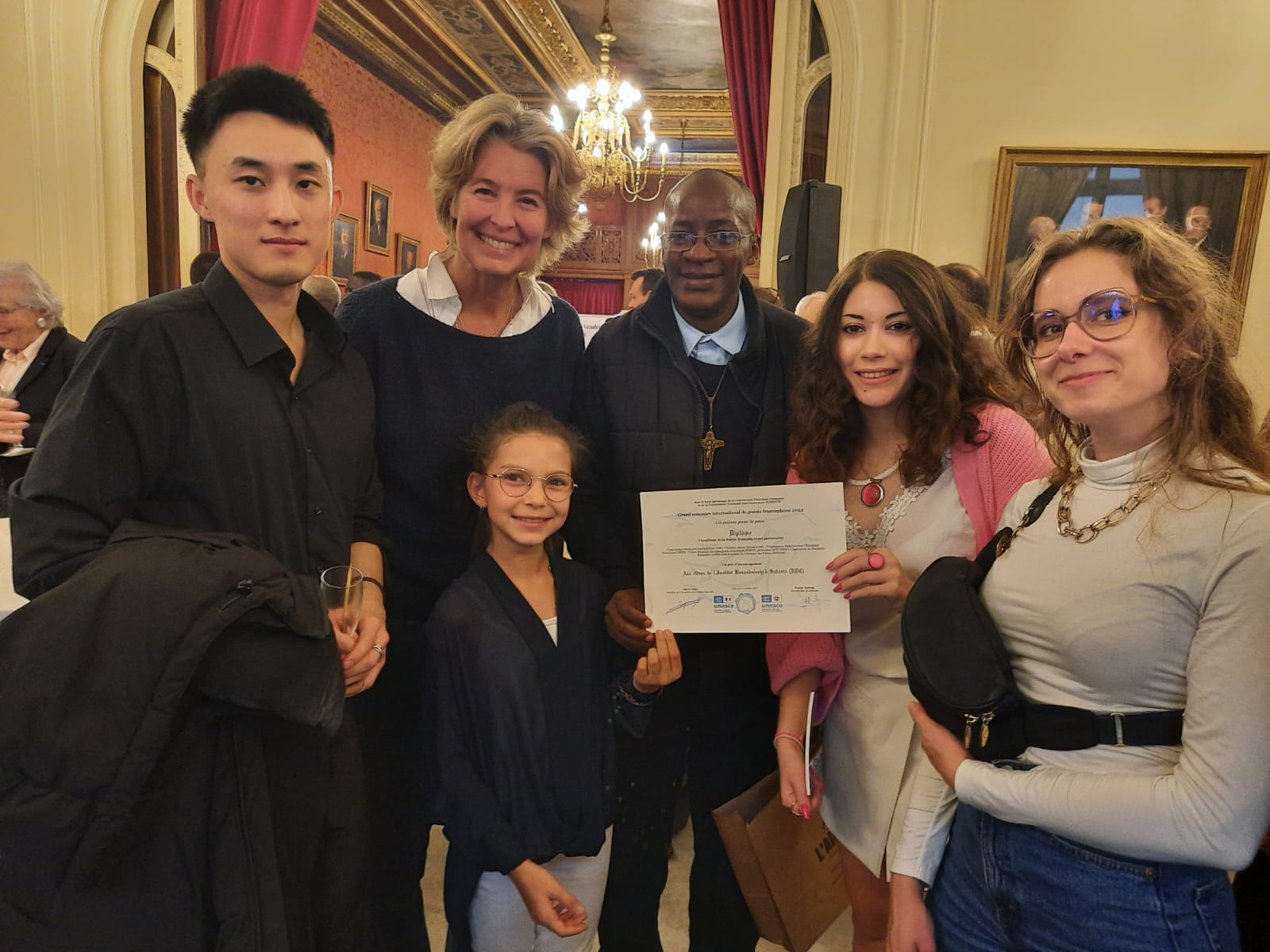
Nous membres de l’UMEC, nous avons participé à la remise du prix du Concours international de poésie francophone 2023 – Un poème pour la paix.

 Ce concours a été organisé sous le haut patronage de la Commission Nationale Française et de la Commission Nationale Ivoirienne pour l’UNESCO.

 Parmi les 500 candidats, les élèves de l’Ecole salésienne Busandulushi de Sakania dans la Province du Haut-Katanga ont participé à ce concours et Busandulushi a été parmi les écoles lauréates. Nous remercions le Père Paulin Longwa et le Professeur Jean Micky qui ont valorisé ce « Poème pour la Paix ».

 Nous exprimons notre gratitude

-          au président de l’Académie de la Poésie Française monsieur Thierry Sajat

-          aux représentant de l’Association Montessori (AMI)

-          aux membres de l’Organisation Mondiale pour l’Education Préscolaire (OMEP)

-          aux membres de l’Association de Médiation Humaniste (AMH)

-          aux membres du  Printemps des Poètes

 Pour cette créativité de nous rassembler pour encourager les talents dans le monde et pour soutenir les initiatives de construire un monde de paix par la poésie.

 L’UMEC encourage cette action du concours qui appelle tout le monde à marcher avec l’objectif de soutenir chaque éducateur à être poète de la paix à chaque instant. Notons qu’il n’y a pas d’éducation sans la paix et il n’y a pas de paix sans l’éducation.

 A cette belle cérémonie tenue à Paris ce 21 Octobre 2023, l’UMEC a été représentée par madame Christine Roche et Albert Kabuge. Nous tenons à remercier les responsables de l’UMEC qui ont accordé cette participation à ce concours qui fait des élèves de Busandulushi les poètes de la paix et qui sont comptés parmi les lauréats de l’Académie de la Poésie Française.

 Nous sommes dans l’attente pour le prochain concours et nous serons disponibles pour y participer avec notre structure pour que nous construisions ensemble la PAIX  et que cette PAIX soit un comportement dans le quotidien de notre vie.


Kabuge Albert, représentant de l’UMEC à Paris